
A bid executive summary must open with the outcome you want the evaluator to reach, then prove you deserve it. State your recommended solution and the strongest reason to award the contract in the first sentence, backed by measurable evidence, not company background. Everything that follows should read as a standalone argument: a buyer could skip the rest of the bid and still know exactly what you are offering and why it wins.
TL;DR:
- A successful executive summary should clearly state the recommended solution and the strongest evidence supporting it upfront to catch evaluators' attention.
- It must directly acknowledge the client's specific situation, using their language, and link each win theme to measurable proof points like past contracts or certifications.
- The summary should follow a structured sequence: client situation, win themes, solution outcomes, evidence, and a clear ask, all within the RFP's specified length limit.
- Including named evidence such as past performance, staff credentials, and certifications ensures each claim is verifiable and strengthens the bid’s credibility.
- Final review by someone outside the bid team is essential, ensuring the summary clearly states what is being asked for and why, with all figures checked against the full proposal.
Table of Contents
- What is an executive summary in a bid, and who actually reads it?
- Objectives and reader-centred framing: the buyer-first rule
- What to include: the checklist evaluators are scanning for
- How long should your bid executive summary be?
- How to write it: process, strawman, and editing
- A reusable template and two short examples
- Common mistakes and a final pre-submission checklist
- Using an AI workspace to speed drafting without losing evidence integrity
- Tailoring the summary to government, corporate, and nonprofit bids
- How to make your competitive advantages land
- Aligning the summary with your wider bid strategy
- One habit that separates the strongest bid writers
- Try an AI workspace built for evidence-led bids
- Sources
- FAQ
What is an executive summary in a bid, and who actually reads it?
A bid executive summary is a decision-focused distillation of your entire proposal, written to be read in isolation. It is not a shorter version of your introduction. It is an argument, compressed to the point where a busy evaluator can grasp your case for winning without reading another page.
The people who read it are rarely the people who wrote the technical specification you are responding to. They are senior decision-makers, panel chairs, and procurement leads scoring against evaluation criteria under time pressure, often after reading five other submissions that morning. Many will read only this section in detail before deciding how carefully to read the rest.
That creates a framing effect. Whatever tone and confidence your summary sets, the reader carries into every subsequent section. A vague or defensive opening primes the evaluator to look for weaknesses. A specific, evidence-backed opening primes them to look for confirmation. Public-sector tender templates reflect this directly: guidance such as Wandsworth's supply tender response template expects the summary to state the proposed solution and its key benefits in a concise, scoring-ready format, not a narrative preamble.
Objectives and reader-centred framing: the buyer-first rule
Before writing a word, decide what action you want the reader to take. Award the contract. Shortlist you for interview. Approve your bid to the next evaluation stage. That action is your objective, and every sentence in the summary should serve it.
Start by acknowledging the client's situation in their own language, not yours. If the tender describes a staffing shortfall, a compliance gap, or a service backlog, name it plainly before you pitch your solution. Evaluators score higher when they recognise their own problem reflected back at them accurately.
From there, select your win themes. Aim for three to four, no more. Experts advise tying each one directly to the tender's evaluation criteria, and choosing only themes you can back with evidence elsewhere in the bid. A win theme with no supporting proof is a claim, not an argument.
Good win themes typically cover:
- Delivery certainty: proof you have run comparable contracts on time and on budget
- Risk reduction: named mitigations for the specific risks this buyer cares about
- Value beyond price: social value, local employment, or sustainability commitments the buyer has flagged as scored criteria
- Fit with the buyer's own priorities: language and outcomes lifted from their own strategy documents or service specification
Pick themes the panel can actually verify against your evidence section. If you cannot point to a case study, metric, or named accreditation for a theme, drop it rather than assert it unsupported.
What to include: the checklist evaluators are scanning for
A recommended structure runs in a specific order: client-situation acknowledgement, win theme statement, solution overview, evidence and proof points, then a closing call to confidence. That sequence, set out by proposal specialists at contrl, works because it mirrors how a sceptical reader actually evaluates a claim. They want to know you understand their problem before they will trust your solution.
1. Client situation acknowledgement. One or two sentences that show you have read the brief properly, using the buyer's own terminology where possible. Avoid restating the whole background; name the specific pain point your solution addresses.
2. Win themes. State each theme as a claim the evaluator can score, not a slogan. "We reduce onboarding time by structured handover" beats "We deliver excellence."
3. Solution overview. Describe the outcome the buyer gets, not your methodology. Evaluators scoring an executive summary want to know what changes for them, not which software modules you use internally.
4. Evidence and proof. This is where most summaries fall short. Generic claims of experience carry little weight; named specifics do.
- Past performance on directly comparable contracts, ideally with the client named where permission allows
- Named roles and staff credentials relevant to this specific contract, not a generic team biography
- Quantified metrics: contracts delivered early, retention rates, cost savings achieved for previous clients
- Live accreditations and certifications relevant to the scoring criteria, stated plainly rather than buried in an appendix
Pro Tip: Keep one evidence sentence in reserve for the summary that you have not used anywhere else in the bid. A single fact the panel has not already read elsewhere makes the summary feel additive rather than repetitive.
5. Call to confidence and next step. Close by stating plainly what you are asking for, whether that is contract award, shortlisting, or a meeting. Do not let the summary trail off on a general statement about your company's values.
A useful discipline throughout: templates that force a three-line formula of recommendation, then the reason in numbers, then the required action produce summaries that decision-makers can act on immediately, rather than summaries that simply describe.
How long should your bid executive summary be?
Best-practice guidance is consistent: write the summary once the rest of the document is finished, and keep it to roughly 1 to 2 pages, or about 5 to 10% of the full document, scaled to the size of the bid. A twelve-page technical response might justify a one-page summary; a sixty-page framework bid can carry two to three.
Whatever length you land on, the RFP's own stated limit always wins. Procurement frameworks frequently cap executive summaries at a fixed word or page count, and exceeding it can see the section disregarded or the whole bid marked non-compliant before scoring even begins.
Within that limit, format for scanning rather than reading start to finish:
- Open with a single headline sentence stating your recommendation, not a scene-setting paragraph
- Keep paragraphs short, generally three to five sentences
- Use bullet points selectively for win themes or key metrics, not as the default structure for the whole section
- Bold sparingly, only around figures or outcomes the evaluator should not miss on a fast read
A single table or graphic can help when it compresses genuinely comparative information, such as a before-and-after metric or a delivery timeline. Avoid decorative visuals or logos that take up scoring space without adding evidence. If a graphic does not change what the evaluator understands, cut it.
How to write it: process, strawman, and editing
The strongest summaries are outlined early and written last. Draft a rough version, a strawman, during your bid strategy session, before the full response exists. Its job is not to be polished. It forces the team to agree on win themes and the core argument before anyone writes a single technical section, so every part of the bid reinforces the same three or four claims.
- Draft the strawman during strategy. Capture the recommendation, the win themes, and the client situation in rough form. This becomes the skeleton the rest of the bid writes towards.
- Write every other section of the bid. Let the technical, pricing, and social value sections generate the actual evidence: figures, named staff, accreditations.
- Rewrite the summary last, once real evidence exists. Replace every placeholder claim in the strawman with a verified fact pulled from the finished bid.
- Fact-check every figure against its source document. A percentage or date that does not match the body erodes trust in the whole submission.
- Cross-check every proof point against the evidence section it references. If the summary claims a metric the body does not support, cut the claim.
- Strip jargon and internal acronyms. Grammarly's business-writing guidance suggests writing for a reader two levels above your project team, someone senior enough to decide, but not necessarily fluent in your delivery terminology.
Pro Tip: Once the summary is finished, hand it to someone who has not read the rest of the bid and ask them to read it alone. If they cannot tell what you are asking for and why you should get it, the summary has failed regardless of how polished the prose sounds.
A reusable template and two short examples
A dependable structure to build from: headline recommendation, then why it matters in provable terms, then three evidence points, then the ask. It compresses cleanly into any page limit and forces you to lead with substance rather than throat-clearing.
- Line 1: State the recommendation and the single strongest reason to accept it
- Lines 2 to 3: Acknowledge the client's situation and state your primary win theme
- Lines 4 to 6: Three evidence points, one per win theme, each with a name, figure, or accreditation attached
- Final line: The specific action you are requesting
Example 1, public-sector service contract.
Before: "Our company has over fifteen years of experience delivering grounds maintenance services across the region and prides itself on quality and reliability."
After: "We recommend awarding this contract to a provider that has delivered grounds maintenance to three comparable local authorities without a single missed service window in the past four years, backed by a dedicated supervisor named for this contract from day one."
Example 2, technical delivery contract.
Before: "We use industry-leading methodologies and a highly skilled team to ensure successful project delivery."
After: "We recommend our fixed-price delivery model, which cut integration time by six weeks on a comparable NHS trust rollout last year, led by the same delivery manager proposed for this contract."
Common mistakes and a final pre-submission checklist
The most frequent fault is starting with the company, not the client. A summary that opens with "Founded in [year]..." has wasted its most valuable sentence. Close behind it: vague superlatives with no metric attached, evidence points that do not match figures quoted later in the bid, and summaries so long they exceed the RFP's own stated limit before evaluators even reach page two.
Run this checklist before submission:
- The first sentence states a decision and a headline reason, not background
- Every win theme is backed by a named, checkable evidence point elsewhere in the bid
- Every figure has been checked against its source in the full document
- The summary sits within the RFP's stated page or word limit
- A colleague who has not read the rest of the bid can explain, from the summary alone, what you are asking for and why
If any item fails, the summary is not ready, regardless of how much time has already gone into it.
Using an AI workspace to speed drafting without losing evidence integrity
An AI-assisted workspace can help by organising your evidence library, past case studies, named staff credentials, accreditations, and linking each piece directly to the win theme it supports. That structure makes the write last, outline first process faster because the proof points are already tagged and ready to insert rather than hunted through old proposals.
Grounding drafts in an organisation's own historical evidence, rather than generic AI output, is the basis of Bidblock's approach to improving bid quality. Even so, AI can accelerate drafting and flag inconsistencies, but every figure and provenance claim still needs a human check before submission. Tools built for AI-assisted tender review work the same way: useful for catching gaps, never a substitute for verifying the underlying facts yourself.
Tailoring the summary to government, corporate, and nonprofit bids
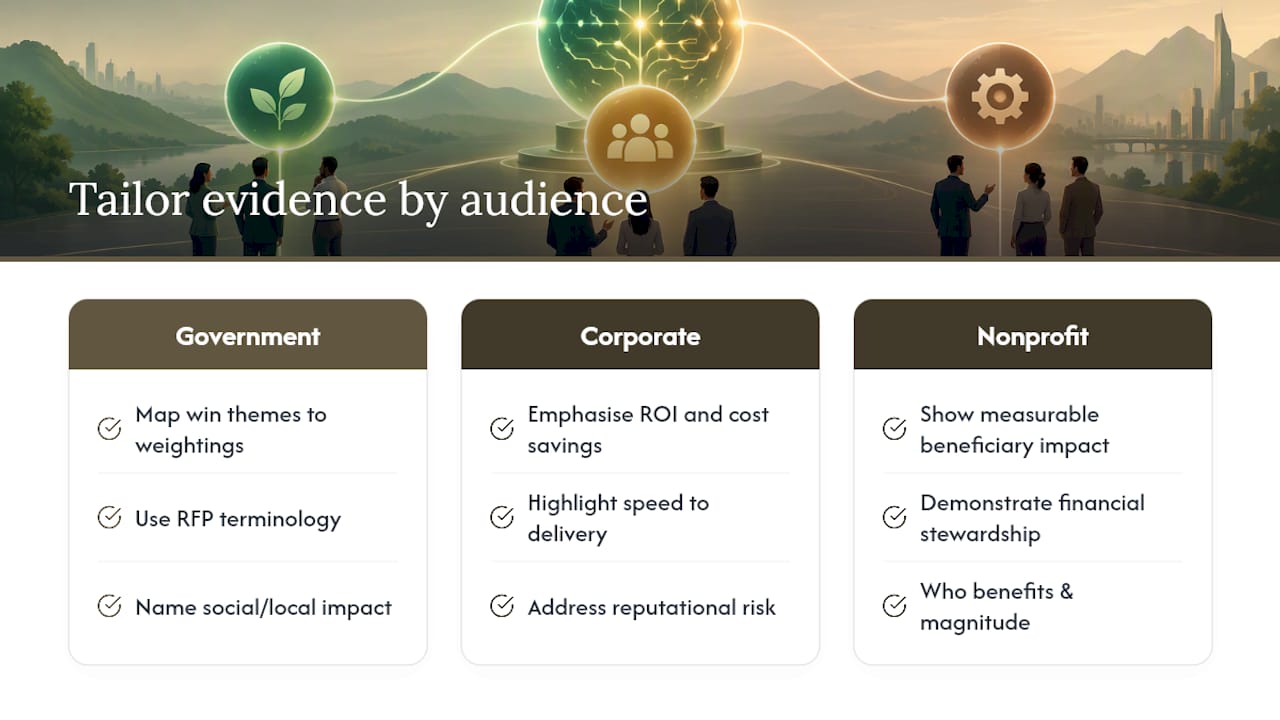
Government and public-sector tenders score against published criteria, often with weighted percentages disclosed in the RFP itself. Your win themes should map directly onto those weightings, using the same terminology the tender document uses, because evaluators are frequently required to score against a checklist rather than a general impression. Social value and local economic impact carry real scoring weight in many public contracts, so name specific commitments rather than gesturing at community benefit.
Corporate bids allow more commercial flexibility. Buyers care about return on investment, speed to delivery, and risk to their own reputation if the contract goes wrong. A corporate summary can lean harder on commercial outcomes, cost savings, revenue impact, time saved, because the reader is usually judged internally on the financial case they make for choosing you.
Nonprofit and grant-adjacent bids reward a different register. Funders and trustees want to see measurable beneficiary impact and evidence of financial stewardship over raw commercial metrics. A nonprofit summary should state who benefits and by how much, then show your organisation can be trusted to deliver that impact without waste.
In every case, read the audience before you read the requirements. A public-sector procurement panel, a corporate buying committee, and a nonprofit board of trustees are persuaded by different kinds of proof, even when the underlying solution you are proposing is identical.
How to make your competitive advantages land
A competitive advantage only works in a summary if it is specific enough that a rival could not plausibly claim the same sentence. "We have a strong track record" is not an advantage; "we have delivered this exact service to two neighbouring authorities without a missed deadline" is.
Rank your genuine advantages before you write, then keep only the two or three you can prove with named evidence. Trying to claim five advantages in a two-paragraph summary dilutes all of them; a panel remembers one sharp, provable claim far better than five soft ones.
Place your strongest advantage in the first or second sentence of the summary, not buried after a page of context. Evaluators scoring quickly reward proposals that make the case early, because it signals confidence rather than padding.
Where possible, tie the advantage to a number the buyer can weigh against competitors: percentage improvement, time saved, cost reduction, retention rate. A number an evaluator can compare across bids does more work than an adjective, however confident it sounds.
Aligning the summary with your wider bid strategy
The executive summary is not a separate writing exercise bolted onto a finished bid. It is the compressed expression of the same strategy that shaped every technical, pricing, and social value section. If your bid strategy identifies three win themes during the kickoff meeting, the summary should be the first place those themes appear and the last place they are reinforced.
That alignment breaks down most often when different people write different sections without checking back against the agreed strategy. A pricing section that leads with cost efficiency but a summary that leads with quality assurance sends mixed signals to an evaluator trying to build a coherent picture of your bid.
Before final submission, read the summary immediately after rereading your win theme statement from the strategy phase. If a theme in the strategy document does not appear in the summary, either the strategy shifted and the document needs updating, or the summary has drifted from the plan and needs correcting. Either gap is worth catching before a panel finds it for you.
One habit that separates the strongest bid writers
The single habit worth adopting from experienced bid teams: write the recommendation sentence first, before anything else, and finalise the summary only after the whole bid is locked. That order forces clarity early and accuracy late.
The second habit worth borrowing: assign one reviewer, ideally someone outside the bid team, to read only the summary in isolation before submission. If they cannot restate your ask in one sentence, the summary is not finished, no matter how much time has already gone into it.
— Syed
Try an AI workspace built for evidence-led bids
An AI-powered workspace can provide bid writers with an evidence library containing past performance, staff credentials, and accreditations, tagged and ready to drop into a summary the moment proof is needed for a win theme. Rather than hunting through old proposals for the right case study, you pull evidence straight into the draft and let the platform's AI review flag gaps before a human reviewer ever sees it.

That matters most in the process this article recommends: strawman early, evidence-backed rewrite late. Requirements analysis and accreditation checks built into some AI workspaces support organising submissions around your own historical wins rather than generic AI phrasing. The Standard plan starts at £29 a month, with Pro and Max tiers for teams managing a heavier tender pipeline, and a Free plan to explore the workspace before committing. Start a bid in the free workspace and see how quickly your own evidence turns into a summary a panel can act on.
Sources
- How to write a winning executive summary for your bid with example | Emphasis
- How to Write a Proposal Executive Summary That Wins | contrl
- Wandsworth tender response template (Supply Wandsworth) | PDF
- Executive Summary: The Ultimate Guide (Examples + Template)
- Executive summary examples and how to write one | HubSpot blog
FAQ
What are the five parts of an executive summary?
The five recommended parts are client situation acknowledgement, a win theme statement, a solution overview, evidence and proof points, and a closing call to confidence, in that order. Following this sequence gives the evaluator your argument in the order a sceptical reader actually needs it.
What is a good example of an executive summary?
A strong example states the recommendation and its strongest proof in the first sentence, then backs three or four win themes with named evidence such as a client reference, a metric, or an accreditation. It avoids company history and closes with a specific, actionable request rather than a general statement of intent.
Can ChatGPT write an executive summary?
AI tools can draft a structure and help check consistency between the summary and the rest of the bid, but they cannot verify your own figures or evidence. Human validation of every number and proof point stays essential regardless of which AI tool assists the drafting.
What should be included in a bid executive summary?
Include an acknowledgement of the client's situation, three to four win themes tied to the evaluation criteria, an outcomes-focused solution overview, named evidence such as past performance and accreditations, and a clear closing ask. Keep it within the length the RFP allows.
How long should a bid executive summary be?
Most guidance suggests 1 to 2 pages or roughly 5 to 10% of the full bid, scaled to the size of the submission. Always check the RFP's own stated limit first, since it overrides any general length guideline.