
Colour team reviews are staged quality checkpoints, usually Pink, Red and Gold, that test a proposal against evaluator criteria before it reaches the buyer. They work only when reviewers are independent of the writing team and every finding gets tracked to a verified fix. Get those two things right and the rest of the process falls into place.
TL;DR:
- Conduct pink and red reviews between 25% and 90% draft completion to ensure findings can be fixed cost-effectively without rushing.
- Keep reviewers independent from the proposal team, specifically avoiding insiders in red team reviews to prevent oversight of logic gaps.
- Use structured scorecards aligned with evaluation criteria and time-boxed sessions to generate actionable, specific feedback within 15 to 20 minutes per section.
- Verify all identified fixes through a dedicated follow-up process to prevent recurring errors and ensure fixes address the original requirement.
- Maintain an integrated evidence library and centralized tracker to streamline review preparation, tracking, and continuous process improvement.
Table of Contents
- What are colour team reviews and why do they matter?
- Standard colour stages: what each one checks
- Who should sit on the review panel?
- When should each review happen?
- How do you turn Section M into a usable scorecard?
- How to structure the review session itself
- Common mistakes that undermine a review
- How does an evidence-driven workspace support better reviews?
- How do you keep improving after the review ends?
- Running a time-boxed review with forms and scorecards
- Practitioner's perspective: what actually moves the needle
- Try an evidence-driven way to run your next review
- Sources
- FAQ
What are colour team reviews and why do they matter?
Colour team reviews exist to convert reviewer judgement into fixable action before a submission goes out the door. Each stage acts as a checkpoint that catches a different category of risk: strategic misalignment, structural gaps, compliance holes, pricing errors, or plain inconsistency. Run properly, a staged review finds these problems while fixes are still cheap. Catch a missing win theme at Pink and it costs an afternoon of rewriting. Catch it after submission and it costs the contract.
The distinction between discovery and verification matters more than most teams realise. Pink and Red are discovery gates, designed to surface gaps the writing team cannot see because they are too close to the material. Gold is a verification gate, confirming that fixes from earlier rounds actually landed and nothing new broke in the process.
That difference shapes what "success" looks like at each stage:
- Pink and Red should generate findings, the more specific the better.
- Gold should generate very few, because by that point the proposal ought to be clean.
- A Gold review full of new findings usually means Red was rushed or under resourced.
Standard colour stages: what each one checks
Every organisation adapts the palette slightly, but five stages cover the core of a well-run bid review process. Each has a distinct question it is trying to answer, and mixing those questions up is one of the fastest ways to waste a review session.
| Stage | Core question | Typical attendees | Exit criteria |
|---|---|---|---|
| Blue | Is the capture strategy and outline sound? | Capture manager, bid director, key SMEs | Outline approved against solicitation structure |
| Pink | Does the draft cover Section L and tell a coherent story? | Proposal manager, writers, SME reviewers | Structural gaps closed, win themes visible |
| Red | Would an evaluator score this well against Section M? | Independent reviewers, senior SMEs, pricing lead | Findings scored and assigned owners |
| Green | Is the price competitive and consistent with the technical volume? | Pricing lead, contracts, finance | Price validated against technical commitments |
| Gold | Is the final document ready to submit? | Executive sponsor, bid director | Sign-off with no open findings |
Two variants are worth knowing; for a detailed example of a structured process, see The Change Order Process: A field guide for trade contractors. A Black Hat review puts reviewers in the shoes of a competitor, stress testing your value proposition against what a rival bidder would likely offer. A White Glove review is a final polish pass focused purely on formatting, grammar and compliance mechanics, often run the day before submission when content is locked.
Who should sit on the review panel?
Panel composition decides whether a review produces evaluator-grade feedback or a round of polite agreement. Follow a short set of rules when assembling reviewers for any stage.
- Invite the capture manager and a technical SME to Blue and Pink, where strategic and structural judgement matters most.
- Bring in a dedicated pricing reviewer for Green, separate from whoever built the cost model, so errors don't get self-marked.
- Keep compliance specialists on every stage from Pink onward, checking the draft against Section L requirements as it evolves.
- Reserve Red Team seats for people who have no writing credit on the proposal.
- Select reviewers for evaluator mindset and relevant domain expertise, not for seniority alone. A mid-level SME with sharp attention to Section M often outperforms a director skimming for typos.
Independence is not a nice-to-have for Red. The single biggest mistake in colour team practice is letting the writing team review its own work, because insiders miss the logic gaps and unstated assumptions an outsider spots immediately. Rotate in a colleague from another business unit, borrow a reviewer from a teaming partner, or maintain a standing pool of trained reviewers who rotate across bids specifically to avoid this trap.
When should each review happen?
Timing decides whether findings can actually be fixed. Run a review too early and you waste reviewer time on a draft that will change anyway; run it too late and there is no runway to act on what reviewers find.
- Pink Team typically runs when the draft sits somewhere between 20% and 70% complete, with most teams converging on 25 to 50%, or 60 to 70% depending on how the Pink stage is scoped in your process.
- Red Team works best at roughly 80 to 90% draft completion, giving reviewers a near-final document to score while leaving enough time to implement changes, a threshold backed by research on red team review timing.
- Gold happens once every Red finding has a verified fix, typically 48 to 72 hours before submission.
Statistic Callout: The most common scheduling failure isn't skipping a stage. It's compressing the calendar so there is no runway left to act on findings once a review finishes. Count backward from the submission deadline, block remediation time first, then fit the review sessions around it. On compressed timelines, merge Pink and Red into a single extended session or run targeted micro-reviews on high-risk sections only, rather than dropping a stage entirely.
How do you turn Section M into a usable scorecard?
Section M sets out the buyer's evaluation factors, and every Red Team scorecard row should map directly to one of them. Vague comments like "this section feels weak" are useless to a writer trying to fix the problem. Structured ratings aren't.
Use a defined rating scale so reviewers score consistently rather than offering subjective taste. A common set, drawn from colour team scoring guidance, runs:
- Strength: exceeds the requirement in a way the evaluator will notice and reward.
- Acceptable: meets the requirement, nothing more.
- Weakness: falls short in a way that could cost points.
- Deficiency: fails to address a requirement at all.
- Risk: introduces a compliance or delivery risk the buyer will flag.
Build a compliance matrix from Section L alongside the scorecard, listing every submission requirement and where it's addressed in the draft. Every reviewer works from the same matrix, which stops three people separately flagging the same missing appendix. Findings themselves need three things to be actionable: the exact problem, the specific requirement it fails against, and a concrete suggested fix, not just a diagnosis.
How to structure the review session itself
A review session without structure turns into a two-hour conversation that produces three usable comments. Time-boxing fixes that.
- Send pre-reads at least 48 hours ahead: the relevant Section L and M extracts, a one-page win-theme summary, and the draft sections under review.
- Open with a five-minute kickoff restating the win strategy, so reviewers score against the intended narrative rather than their own assumptions.
- Time-box each section, typically 15 to 20 minutes per major volume, with reviewers scoring independently before discussion opens.
- Hold a caucus after each section to adjudicate disagreements and assign an owner to every finding on the spot.
- Consolidate everything into one findings tracker immediately after the session, with severity, owner and due date attached to each line.
Pro Tip: Never let findings live in scattered email threads or marked-up PDFs. A single tracker with a verification column, showing not just that a fix was made but that someone checked it, is what separates a review that improves the proposal from one that just generates paperwork. Formal adjudication matters because feedback without follow-through produces no return on the time reviewers spent giving it.
Common mistakes that undermine a review
Most review failures trace back to a handful of repeated errors, and most are avoidable with a small process change.
- Letting the proposal writers act as their own Red Team reviewers, which removes the independence the stage depends on.
- Scheduling a gate so late, or without pre-reads, that reviewers arrive unprepared and findings arrive too late to fix.
- Scattering feedback across comments, emails and verbal notes instead of one findings tracker with named owners.
- Inviting senior executives to every stage purely for optics, which slows sessions down without improving the scoring.
- Treating Gold as a discovery gate rather than a verification pass, so new issues surface when there's no time left to fix them.
How does an evidence-driven workspace support better reviews?
Preparing for Pink or Red usually eats more time than the review itself, chasing past win themes, hunting accreditation documents, rebuilding a compliance matrix from scratch. A workspace built around a reusable evidence library removes most of that friction, since past case studies and social value evidence sit ready to slot into a draft rather than being rewritten each time. Bidblock builds its platform around this model and reports a 75% win rate as a result, a figure the company attributes to grounding drafts in prior evidence rather than generic AI text. A structured workspace can also host the compliance matrix, reviewer scorecards and a single findings tracker in one place, which keeps Section L and M references live throughout the review cycle instead of scattered across separate documents.
How do you keep improving after the review ends?
The review doesn't finish when the session ends. What happens in the following days decides whether the same mistakes show up on the next bid.
Start by closing the loop on every finding from the consolidated tracker. Each item needs a verification step, someone other than the person who made the fix confirming it actually addresses the requirement cited, not just that a change was made somewhere near it. Skipping verification is how "fixed" findings quietly reappear in the final document.
Once the bid is submitted, hold a short debrief separate from the submission scramble. Pull the findings tracker and look for patterns: did the same compliance gap show up in three different sections? Did Red Team catch something Pink should have caught earlier? A formal debrief that categorises findings by impact turns individual bid lessons into process improvements, rather than letting them evaporate once the deadline passes.
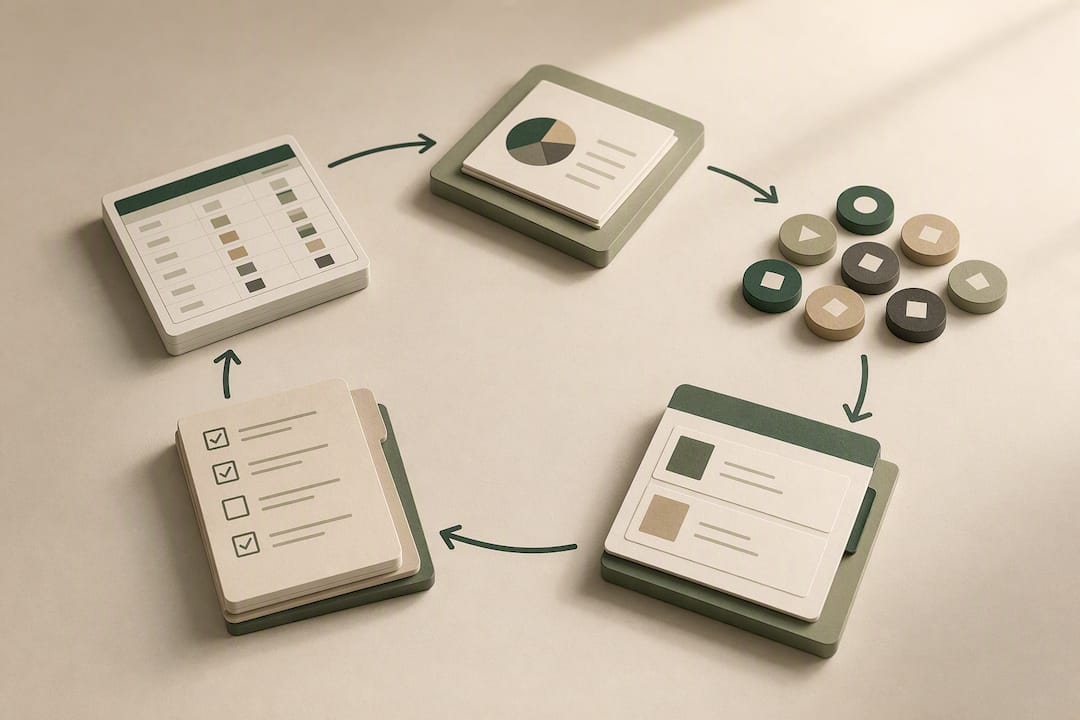
Feed recurring issues back into your templates and checklists. If Pink reviews keep flagging the same missing evidence type, that's a sign your evidence library needs updating, not that reviewers keep getting unlucky. If Red Team scorecards repeatedly show weak Section M coverage in the same volume, that's a training gap worth addressing before the next capture cycle starts, not after.
Finally, retire outdated review forms. A scorecard built for one solicitation type won't fit every bid. Revisit your stage-specific forms every few bid cycles and strip out questions that never generate useful findings.
Running a time-boxed review with forms and scorecards
A stage-specific review works because the form constrains what reviewers look at, stopping Pink sessions drifting into pricing debates or Gold sessions reopening strategy questions that were settled weeks earlier.
Build a distinct scorecard for each stage rather than reusing one generic form. A Pink scorecard should ask structural questions: does this section address every Section L requirement, is the win theme visible in the first paragraph, does the narrative flow logically. A Red scorecard should ask evaluator questions: applying the strength, acceptable, weakness, deficiency and risk ratings against specific Section M factors.
Time-boxing only works if the form forces reviewers to move on. Give each reviewer a fixed window, commonly 15 minutes per major section, to score independently using the form before any group discussion starts. This stops the loudest voice in the room dominating the conversation before quieter reviewers have logged their own view.
Structure the form itself around three fields for every finding: the specific issue, the exact requirement or evaluation factor it relates to, and a suggested fix. A form that only allows a free-text comment box invites vague feedback; one that demands all three fields forces reviewers to think in evaluator terms rather than personal preference.
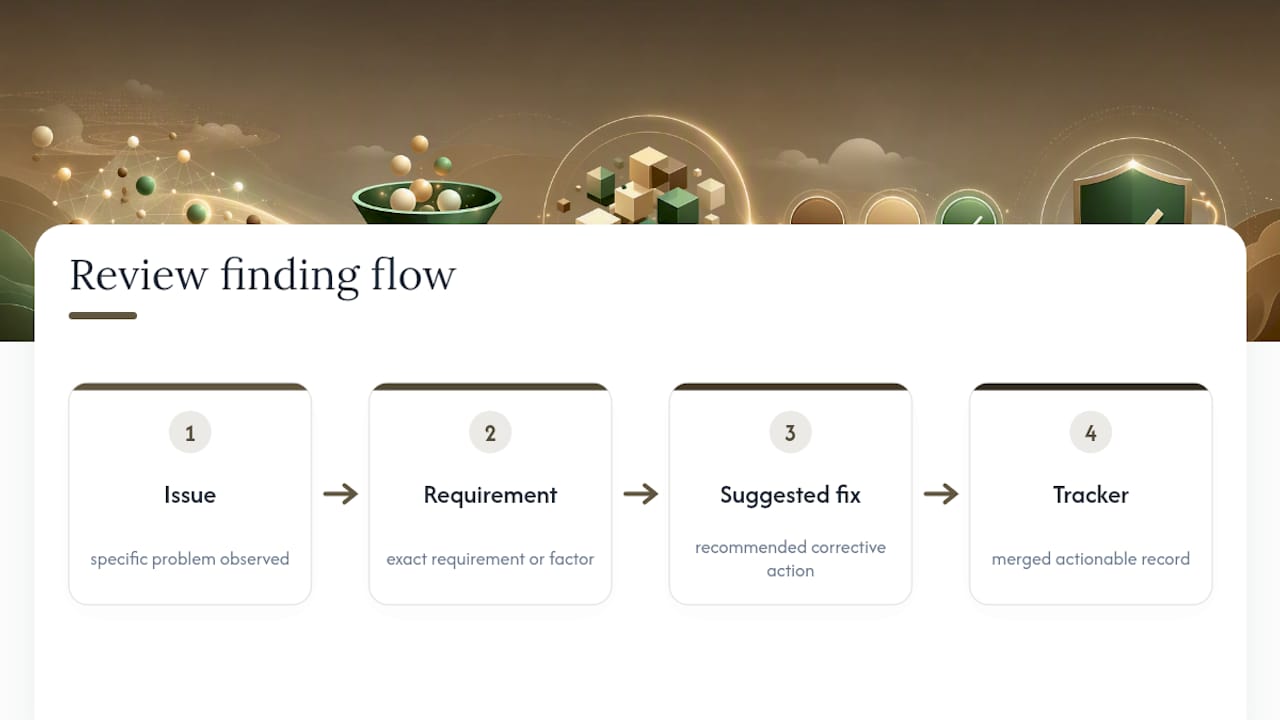
Close the session with the form outputs, not a verbal summary. Whoever runs the review should collect every completed scorecard immediately and merge the findings into the single tracker before reviewers disperse, while context is still fresh and before contradictory feedback gets lost in someone's inbox.
Practitioner's perspective: what actually moves the needle
Protect Red-team independence above everything else, then insist on verified fixes. Small teams can shrink the panel, but never skip the outside reviewer or the tracker.
— Syed
Try an evidence-driven way to run your next review
Bidblock is built for teams who want the discipline of colour team reviews without rebuilding a compliance matrix from scratch on every bid. The platform keeps your evidence library, past win themes and accreditation documents in one place, so Pink and Red preparation takes hours rather than days, and reviewers can score against Section M inside the same workspace where the draft lives.

Findings, owners and verification status stay in one tracker rather than scattered across comments and email threads, which is exactly the discipline this article argues for. Plans start with a free tier and scale through Standard, Pro and Max as your pipeline grows. Visit the Bidblock workspace to start a free trial and see how your next review runs with a live compliance matrix already built.
Sources
- The importance of red team reviews
- Pink-team, red-team, gold-team proposal review guide
- Effective debriefing with guided performance review (Monash University)
FAQ
What is the Shipley proposal method?
The Shipley method is a structured approach to proposal development that organises bid work around defined phases, capture, planning, drafting and review, with colour team reviews acting as the quality gates between them. It is widely used as the reference model behind Pink, Red and Gold reviews in government and enterprise bidding.
What does "red team review" mean?
A red team proposal review simulates the buyer's evaluation process using reviewers who had no role in writing the proposal, scoring the near-final draft against the solicitation's evaluation criteria. It typically runs at 80 to 90% draft completion so there is time to fix what it finds.
What is a gold team review?
A gold team review is the final verification gate before submission, confirming that every finding from earlier reviews has been fixed and the document is ready to send. Unlike Pink or Red, it is not meant to generate new findings, only to catch anything that slipped through.
What is a pink team review?
A pink team review checks an early to mid-stage draft for structural completeness and coverage of the solicitation's submission requirements, commonly run somewhere between 20% and 70% draft completion depending on the team's process. It is the most cost-effective stage to get right, since fixing structural gaps here is far cheaper than fixing them later.
Who should never be a red team reviewer?
Anyone who wrote or edited the proposal content should not sit on its Red Team panel, since independent reviewers catch gaps that writers miss by virtue of not being close to the material. Bidblock's workspace approach supports this by keeping evidence and drafting separate from the review workflow, making it easier to bring in genuinely independent reviewers.