
Start with two portals: Find a Tender for above-threshold public sector notices, and Contracts Finder for many central-government opportunities below that line. Add devolved and sector feeds relevant to your work. Then take the one action that matters most: set a saved search or email alert on at least one of these portals today, so opportunities come to you instead of the other way round.
TL;DR:
- Using multiple portals such as Find a Tender, Contracts Finder, and devolved regional sites ensures you identify all relevant opportunities across different regions and contract values.
- Setting precise alerts with targeted role, outcome terms, and CPV codes increases the relevance of notices and prevents time wasted on irrelevant tenders.
- Monitoring pre-procurement and pipeline notices offers early signals of upcoming tenders, helping you prepare and react faster than competitors who only focus on live notices.
- Verifying tender legitimacy through official portals and matching notices with public bodies prevents wasting effort on suspicious or fraudulent opportunities.
- Building a routine, combining alerts, eligibility checks, and a shared evidence library enables consistent, efficient bid discovery and response preparation.
Table of Contents
- How to find tenders: official UK portals and when to use each
- How to build saved searches and alerts that actually work
- How early can you spot a tender before it's published?
- Prioritising leads: which tenders are worth your time?
- A practical workflow for finding and acting on tenders
- How to verify the credibility and legitimacy of tender opportunities
- How to network with procurement officers before tenders go live
- Open, restricted, and negotiated procedures explained
- Common pitfalls in tender searching and how to avoid them
- Author perspective: what actually separates consistent bidders from occasional ones
- Where BidBlock fits into your tender search
- Sources
- FAQ
How to find tenders: official UK portals and when to use each
Knowing how to find tenders in the UK starts with matching the right portal to the right contract value and region. Each one serves a distinct slice of the market, and using the wrong one wastes time.
- Find a Tender: the primary UK portal for publishing procurement notices. Since February 2025 it covers the full notice lifecycle for qualifying contracts, from pipeline notices through to award. Above-threshold notices, historically those over the usual threshold including VAT, sit here. Use its Notice Search for detailed filtering and Summarised Search when you want a faster overview of live opportunities.
- Contracts Finder: lists central-government contract opportunities, commonly from around £12,000 including VAT. Suppliers can create a free account, save searches, and receive email updates when matching notices appear.
- Devolved portals: Public Contracts Scotland covers Scottish buyers, Sell2Wales covers Welsh public bodies, and eTendersNI is Northern Ireland's principal notice portal. If your business operates or wants to operate across borders within the UK, check all four national portals rather than assuming England-based feeds cover everything.
- Sector and local feeds: NHS trusts and local councils frequently publish smaller-value opportunities directly on their own procurement pages, and framework providers publish call-off opportunities that never appear on the national portals at all.
For cross-border work, TED (Tenders Electronic Daily) lists procurement notices across many European countries, useful if you're eyeing international public sector contracts alongside UK ones.
How to build saved searches and alerts that actually work
Alerts only earn their keep when the search behind them is precise. A vague keyword search returns hundreds of irrelevant notices and trains you to ignore your inbox, which defeats the purpose entirely.
- Start with role and outcome terms, not generic nouns. "Grounds maintenance" beats "gardening services"; "domiciliary care" beats "care". Add synonyms buyers actually use in notices, and exclude terms that create false positives (a facilities-management search might need to exclude "construction" if you don't do capital works).
- Use CPV codes alongside keywords. Common Procurement Vocabulary codes narrow results far more reliably than free text, because buyers classify notices against a fixed taxonomy rather than natural language.
- Layer filters: contract value, region, and notice type (open, restricted, pre-procurement) cut noise fast when combined rather than used one at a time.
- Set alert frequency to daily, not weekly, for anything time-sensitive, then review and refine the search after two or three weeks based on what's actually landing in it.
Pro Tip: Run the same search on Find a Tender and Contracts Finder with identical keywords first, compare what each surfaces, then adjust each search independently. The two portals rarely return identical results even for the same sector.
A cleaning contractor might set searches around "cleaning services" plus relevant CPV codes, filtered to their operating region and contracts under an appropriate value cap. A specialist IT consultancy might instead filter by CPV code alone, nationwide, with no value cap, since their opportunities are rarer and more scattered.
How early can you spot a tender before it's published?
Live notices are the visible tip of a much longer procurement cycle. Buyers often signal intent well before a notice goes live, and reacting only when a full tender appears means starting later than competitors who tracked the run-up.
- Pre-procurement and pipeline notices flag a buyer's intention to go to market, sometimes months ahead. Preliminary market engagement guidance under the Procurement Act 2023 encourages buyers to publish these early signals and even invite supplier input before the formal tender.
- Award notices reveal incumbents, contract values, and start dates. Tracking who currently holds a contract tells you when it's likely to come back to market, which is one of the more reliable ways to forecast timing rather than guess.
- A simple tracker listing expiry dates, framework start dates, and reminder points beats memory every time, even a basic spreadsheet with three columns does the job.
Prioritising leads: which tenders are worth your time?
Not every notice deserves a bid. Filtering fast protects the hours you'd otherwise spend chasing contracts you were never going to win.
- Check the buyer, value, and route first. Does the contract value match your delivery capacity? Is it open, restricted, or a framework call-off, and does that route suit you?
- Confirm essential accreditations before anything else. If a notice requires a specific certification you don't hold and can't obtain before the deadline, stop there.
- Score effort against reward quickly: a five-minute read of the specification should tell you whether the win probability and contract value justify a multi-day bid effort.
- Watch for red flags: unusually short deadlines with heavy documentation requirements, specifications that seem written around a single named product, or notices with no clear evaluation criteria. These often signal a foregone conclusion or a poorly planned procurement, and both waste your time.
A practical workflow for finding and acting on tenders
Discovery only pays off if it feeds a repeatable process. A six-step workflow keeps a small team from losing good leads in a crowded inbox.
- Define your criteria — sector, value range, region, accreditation requirements.
- Set saved searches and alerts across the relevant portals from section one.
- Triage daily, sorting new notices against your eligibility checklist within minutes, not days.
- Run eligibility checks on anything that clears triage: buyer, deadline, accreditation, procurement route.
- Assign an owner to each live opportunity so nothing sits unclaimed.
- Start the response with enough lead time to address every requirement properly.
Manual tracking in a spreadsheet works for occasional bidders. Once you're tracking multiple live opportunities and past submissions at once, software that holds an evidence library and lets a team collaborate on drafts saves real time, particularly when reusing past answers rather than rewriting them from scratch each time.
Pro Tip: Keep a running "evidence bank" of your strongest past answers, sorted by theme (quality, social value, methodology), even before you invest in dedicated software. It's the single habit that saves the most time later.
How to verify the credibility and legitimacy of tender opportunities
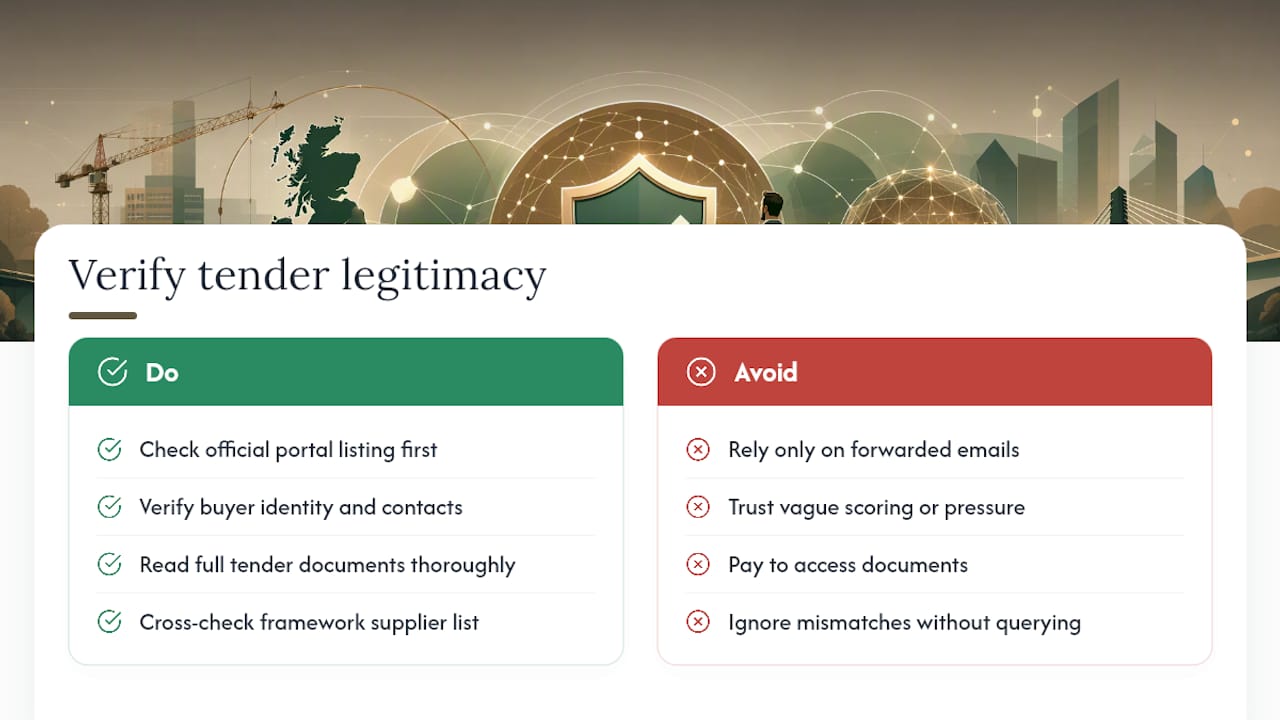
Genuine public sector notices always originate from an official portal or a buyer's own verified procurement page, never solely from a third-party email or unsolicited message. Before committing time to any opportunity, confirm the notice exists on Find a Tender, Contracts Finder, or the relevant devolved portal. If a notice only appears via a forwarded link with no matching listing on an official source, treat it with suspicion.
Check the buyer's identity against a known public body. Local councils, NHS trusts, and government departments all have published contact details and existing procurement pages. A quick search should confirm the organisation is real and that its procurement contact details match what's listed in the notice, not a separate email domain.
Read the full documentation, not just the summary. Legitimate notices carry a clear evaluation methodology, defined submission deadline, and named contracting authority. Vague scoring criteria, pressure to respond unusually fast, or requests for payment simply to access tender documents are inconsistent with how UK public procurement operates and warrant a call to the buyer's contracts team before you proceed.
Cross-reference framework opportunities against the framework provider's own published supplier list. Genuine call-off opportunities under an established framework will match records held by the framework operator, and any mismatch is worth querying directly before you invest effort in a response.
How to network with procurement officers before tenders go live
Formal notices aren't the only route into a buyer's pipeline. Many procurement teams run supplier engagement events, market-warming sessions, or informal briefings ahead of a tender going live, and these sit squarely within what preliminary market engagement guidance under the Procurement Act 2023 actively encourages.
Attend buyer-hosted "meet the supplier" events where they exist. Councils and NHS trusts occasionally run these ahead of major re-procurements, and they're a legitimate opportunity to ask questions that shape how you position a future bid, not to lobby for special treatment.
Register interest directly with a buyer's procurement team where a pre-procurement notice invites supplier feedback. Responding to these consultations puts your name on record early and sometimes influences how the eventual specification is written.
Keep contact with procurement officers professional and factual. Ask about upcoming pipeline work, clarify scope on live notices through the official question-and-answer channel rather than direct contact, and never request preferential information outside the process; that risks disqualification and damages your standing for future opportunities. Trade bodies and sector events also connect suppliers with procurement contacts informally, which often surfaces pipeline intelligence well before it reaches a public notice.
Open, restricted, and negotiated procedures explained
Procurement procedures determine how you bid, not just what you're bidding for, and mixing them up wastes preparation time.
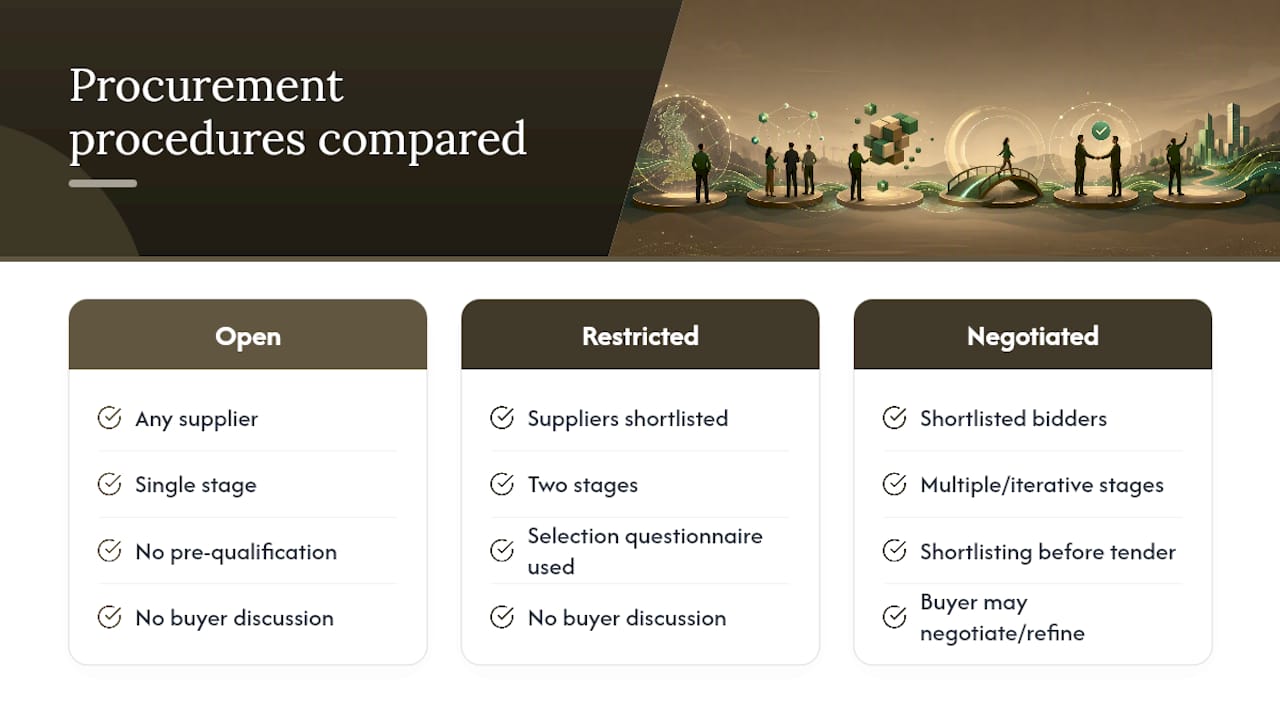
Open procedure lets any supplier submit a full tender response directly, with no pre-qualification stage. It suits straightforward contracts where the buyer expects a manageable number of bidders and wants maximum competition from the outset.
Restricted procedure runs in two stages: suppliers first submit a selection questionnaire, and only those who pass go on to submit a full tender. Buyers use this for complex or high-value contracts where they want to filter for capability and financial standing before reading detailed technical proposals.
Negotiated procedure (including competitive procedure with negotiation) allows the buyer to discuss and refine requirements with shortlisted bidders before final submissions. This suits contracts where the specification isn't fully fixed at the outset, such as complex services or innovative technical solutions.
The Procurement Act 2023 reshaped some of this terminology and notice publication requirements from February 2025 onward, so always check a notice's stated procedure type against current GOV.UK guidance rather than assuming older terminology still applies exactly as before. Frameworks add a further layer: once you're on one, individual call-offs may use a simplified mini-competition rather than a full procedure from scratch.
Common pitfalls in tender searching and how to avoid them
Relying on a single portal is the most common mistake. A supplier who only checks Find a Tender misses the Contracts Finder notices below threshold, and misses devolved or local council opportunities entirely, since live tenders are published across multiple portals depending on buyer and region.
Broad, generic keyword searches are the second-most common trap. Searching just "consultancy" or "maintenance" buries genuine opportunities under hundreds of irrelevant results, and most people give up checking alerts within weeks when this happens.
Ignoring pre-procurement and pipeline notices costs valuable lead time. Suppliers who only react to live notices start their bid preparation weeks behind those who spotted the pipeline signal months earlier.
Skipping eligibility checks before investing bid effort is a quieter but costly pitfall. Missing an essential accreditation on page 40 of a specification after two days of drafting wastes far more time than a five-minute check at the start would have.
Finally, treating tender searching as a one-off task rather than a standing process means good opportunities slip through simply because nobody was watching that week. Building a routine, even a basic one, beats sporadic effort every time.
Author perspective: what actually separates consistent bidders from occasional ones
The businesses that win repeatedly aren't the ones with the cleverest search terms. They're the ones who treat pipeline tracking as routine, not an afterthought, and who never rely on a single portal or a vague keyword. Most missed opportunities come from inattention, not incompetence. This week: set one alert, write a five-line eligibility checklist, and assign someone to own it. That's the whole starting point.
— Syed
Where BidBlock fits into your tender search
Bidblock gives you one place to catch opportunities that a portal alert alone would miss, then turns discovery straight into a working draft using your own past evidence rather than a blank page. It combines tender discovery, an evidence library built from your previous submissions, accreditation checks, and AI-assisted response drafting in a single workspace, and some users report a positive outcome rate.

It suits small businesses, consultants, and training providers who are already searching multiple portals manually and want the discovery-to-draft process consolidated rather than scattered across spreadsheets and email folders. If you're also managing the admin side of winning public sector work, invoicing tools built for contractors can help once contracts land. To see how Bidblock handles your own sector and value range, visit the Bidblock landing page and start a trial.
Sources
FAQ
How can I find tenders in the UK?
Start with Find a Tender for above-threshold notices and Contracts Finder for many central-government contracts from around £12,000, then add the devolved portal relevant to your region.
How can I find tenders for the NHS?
NHS trusts publish many opportunities directly on their own procurement pages alongside listings on Contracts Finder and Find a Tender, so checking both the national portals and specific trust websites gives the fullest picture.
How do I find public sector tenders below the national thresholds?
Lower-value public sector work often appears on council procurement pages, NHS trust sites, and framework provider portals rather than the national services, so local and sector-specific feeds matter as much as Find a Tender.
Which is the best website to search for tenders?
There isn't a single best site. Find a Tender and Contracts Finder cover the most ground for UK-wide central-government work, but devolved portals and sector feeds catch opportunities the national services miss entirely.
How do CPV codes help with tender searches?
CPV codes classify contracts by sector using a fixed taxonomy, which returns more relevant results than free-text keyword searches alone and cuts down on irrelevant notices cluttering your alerts.