
If you are bidding for a UK central government contract worth £5 million a year or more, you need a Carbon Reduction Plan before you can proceed past selection. There is no way round it: publish a compliant plan, signed off by a director, on your own UK website, using the GOV.UK Carbon Reduction Plan template, and do it now if you have not already.
TL;DR:
- A compliant Carbon Reduction Plan must include a net zero commitment, scope 1 and 2 emissions, and five specific scope 3 categories, all signed off by a director.
- Accurate calculation using the GHG Protocol, clear baseline years, and specific measures for the contract are essential to pass the compliance check.
- Failure to publish, update every 12 months, or include all required fields can lead to automatic rejection during procurement evaluation.
- Evidence gathering should start early with existing invoices, logs, and documentation, simplifying updates for future bids and maintaining credibility.
- Even small suppliers face strict compliance requirements, with non-compliance typically leading to exclusion from the contract opportunity.
Table of Contents
- What is the PPN 06/21 carbon reduction plan requirement?
- How do you complete each carbon reduction plan field correctly?
- What mistakes cause CRPs to fail the compliance check?
- How is a carbon reduction plan assessed in procurement?
- Gathering evidence without missing a required field
- Practical priorities for UK SMEs and first-time bidders
- Preparing your carbon reduction plan without the last-minute scramble
- Primary GOV.UK documents to check before you submit
- Sources
- FAQ
What is the PPN 06/21 carbon reduction plan requirement?
PPN 06/21, now formally known as PPN 006 under the Procurement Act 2023 regime, requires suppliers bidding for central government contracts anticipated at £5 million per annum or above to publish a Carbon Reduction Plan (CRP) and commit to Net Zero by 2050. It applies to new procurements launched from 30 September 2021, and the rules that govern completion sit in the accompanying technical standard.
The CRP is not a marketing document or a general sustainability report. It is a structured, templated statement covering specific emissions scopes, a named director's approval, and a public commitment. Here is what a compliant plan must contain, matched directly against the GOV.UK template fields:
- A Net Zero commitment statement, targeting net zero by mid-century at the latest, with a signed declaration.
- Scope 1 and Scope 2 UK emissions totals, reported against a clearly stated baseline year.
- The five required Scope 3 categories where relevant: business travel, employee commuting, waste from operations, upstream transport and distribution, and downstream transport and distribution.
- Environmental management measures specific to delivering this contract, not generic corporate policy statements.
- Director-level approval showing name, job title and date, published on the supplier's UK website, updated regularly.
Miss any one of these and the plan risks failing the compliance check at selection stage, regardless of how ambitious your climate targets sound elsewhere, because this is a mandatory requirement.
How do you complete each carbon reduction plan field correctly?
Working through the technical standard field by field removes most of the guesswork. Here is the practical sequence that works for most first-time bidders:
- Scope 1 and Scope 2. Include fuel combustion, company vehicles and purchased electricity. Calculate using the GHG Protocol Corporate Standard and current UK conversion factors from DEFRA. Do not substitute an internal estimate for a recognised methodology.
- Scope 3. You only need the five categories listed above, not the full fifteen the GHG Protocol defines. Where full data are unavailable, use a reasonable estimate and document your assumptions clearly. Assessors expect transparency about methodology gaps, not silence on them.
- Baseline year and reporting period. Pick one consistent baseline year and stick with it across future updates, so year-on-year comparison is possible. State your current reporting year distinctly from the baseline.
- Environmental management measures. This is where generic plans fail most often. Describe what you will actually change while performing this specific contract, with timelines and measurable indicators, not a restated corporate ESG policy.
- Sign-off and publication. A named director, their job title, and the date of approval must appear on the document. A physical signature is not required, a typed name with role and date satisfies the standard. Publish it somewhere visible on your UK website; if you have no website, you will need to create a minimal public page rather than emailing it privately.
- Assurance. Internal reasonable assurance is acceptable for most CRPs. Larger suppliers or those with complex operations sometimes seek third-party verification under standards like ISO 14064-3 or ISAE 3410, but this is not mandatory for most contract values.
Pro Tip: Keep a working spreadsheet mapping each template field to its evidence source (invoice, mileage log, waste contract) before you draft a word of narrative. It turns a two-day writing task into a half-day one.
What mistakes cause CRPs to fail the compliance check?
Most rejected plans fail for avoidable reasons, and the fixes are usually quick once you know what assessors are checking for.
- Submitting a CSR or ESG report instead of a CRP. Use the official template, or make sure every required field from the technical standard appears somewhere in your document.
- Missing or vague director sign-off. Name the approver, their job title, and the date. A signature block from "the sustainability team" will not pass.
- Omitting Scope 3 categories or mixing reporting periods. Include all five required categories and keep the reporting year consistent throughout the document.
- Describing policy instead of action. Reframe vague commitments ("we aim to reduce emissions") as specific, timetabled actions tied to contract delivery.
- Failing to publish, or letting the plan lapse. CRPs need refreshing every 12 months, and buyers expect to find them live on your website, not sent as a PDF attachment on request.
How is a carbon reduction plan assessed in procurement?
A CRP is not scored competitively against other bidders' plans. GOV.UK's own guidance confirms that assessment is a compliance check, not a comparative evaluation, so a technically complete plan from a small supplier carries the same procurement weight as one from a large contractor.
- Threshold and scope: applies where the anticipated contract value is above a specified threshold defined in government policy (generally ex VAT), applied proportionately to frameworks and Dynamic Purchasing Systems where individual call-offs meet that value.
- Timing: buyers typically request a link to your published CRP during the Selection Questionnaire stage, before technical evaluation begins.
- Validity: plans must be updated at least every 12 months to remain current.
- Subcontractors and overseas suppliers: buyers may ask for UK-specific operational data even from overseas bidders competing for UK contracts.
- Consequences of failure: a non-compliant CRP typically means exclusion from that procurement, not a lower score, so it is worth treating this as a hard gate rather than a "nice to have" section.
Note that for procurements commenced on or after 24 February 2025, the Procurement Act 2023 and its regulations introduced updated terminology, but PPN 06/21 remains the live technical reference for CRPs, and existing compliant plans do not need rewriting purely because of the naming change.
Gathering evidence without missing a required field
Most delays happen at the data-gathering stage, not the writing stage. Before drafting anything, pull together energy invoices, fuel logs, business travel records, waste contracts, and delivery or logistics procedures. If you already hold a prior carbon footprint calculation, use it as your baseline rather than starting from zero.
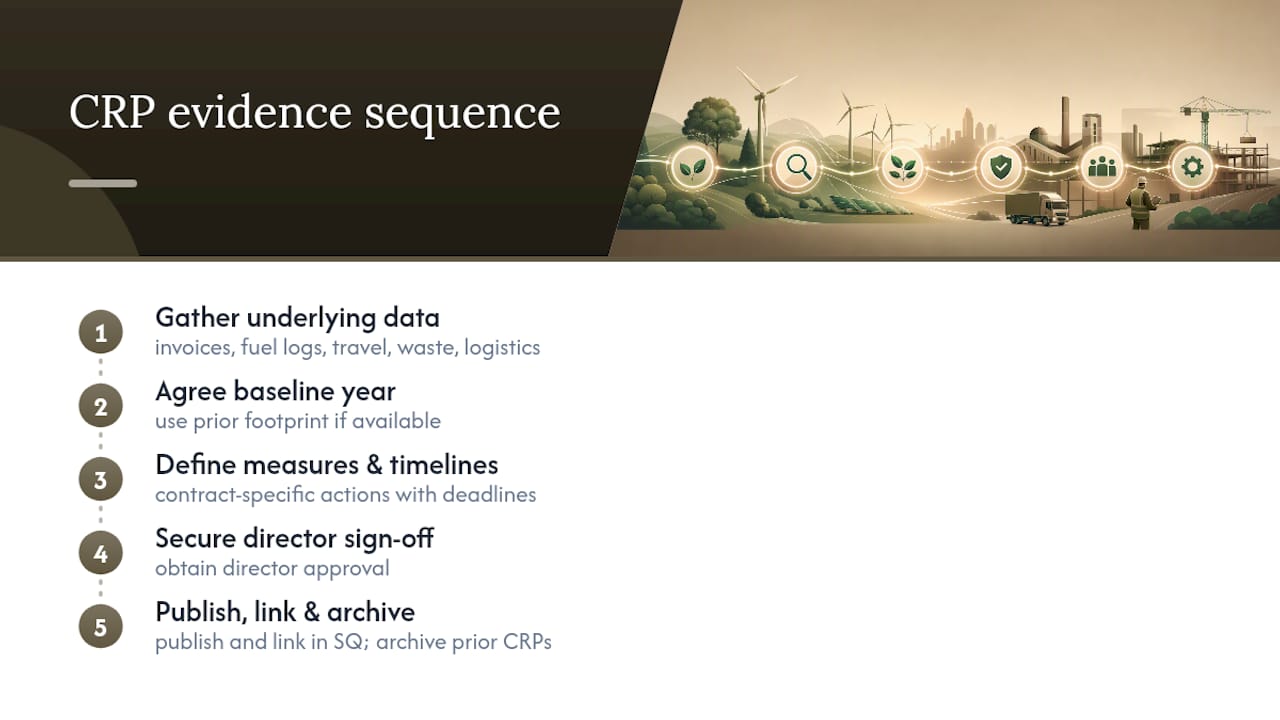
A practical sequence: gather the underlying data, agree and state your baseline year, draft contract-specific measures with timelines, secure director sign-off, then publish and link the plan wherever your Selection Questionnaire response asks for it. Reviewers also value seeing prior CRPs archived on your website, since it lets them check year-on-year progress rather than taking a single statement on trust.
Pro Tip: Build an evidence library once, tagged by scope and category, and every future bid becomes a matter of updating figures rather than starting the whole document from scratch.
Practical priorities for UK SMEs and first-time bidders
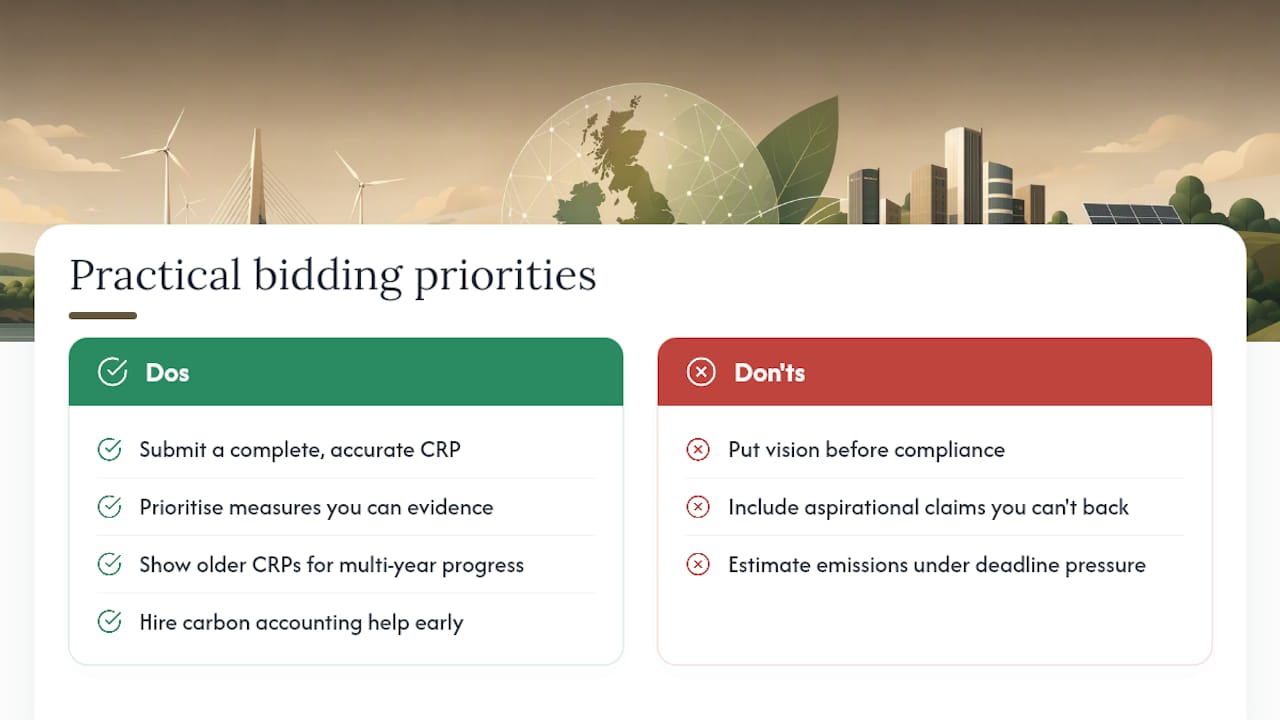
Get the template right before you polish long-term ambitions. Assessors check compliance, not vision, so a complete, accurate plan beats an inspiring but incomplete one every time.
Focus your limited time on measures you can genuinely deliver and evidence within the contract period, not aspirational statements you cannot back up. Keep older CRPs visible alongside the current one; a supplier showing three years of steady, documented progress reads as more credible than one presenting a single polished document with no history behind it. If your emissions data spans multiple sites or complex logistics, it may be worth bringing in specialist carbon accounting support before your next major bid, rather than estimating under pressure close to a deadline.
— Syed
Preparing your carbon reduction plan without the last-minute scramble
Most suppliers lose time chasing invoices, mileage records and sign-off emails in the final week before submission, precisely when tender responses need the most attention elsewhere. An AI-powered workspace can keep your evidence library for supporting documents, a structured drafting workflow aligned to procurement requirements, and an approvals step for director sign-off all in one place.
If your next bid depends on a compliant, well-evidenced Carbon Reduction Plan alongside a strong technical response, start with Bidblock's tender workspace and see what a structured evidence library does to your submission timeline.
Primary GOV.UK documents to check before you submit
Confirm your CRP against the PPN 06/21 policy page and the technical standard, which contains Annex A and the exact reporting rules. NHS bidders should also read the NHS England guidance for sector-specific expectations.
Sources
- Gov
- Carbon reduction plan requirements for the procurement of NHS goods, services and works - NHS England
FAQ
What is PPN 006?
PPN 006 is the current name for PPN 06/21 under the Procurement Act 2023 framework. It requires suppliers bidding for major government contracts worth £5 million per annum or more to publish a compliant Carbon Reduction Plan.
What are the UK government's plans to reduce carbon emissions?
Beyond procurement rules like PPN 06/21, the UK government has committed to reaching Net Zero greenhouse gas emissions by 2050, a target that shapes public sector buying decisions, supplier requirements, and infrastructure investment across departments.
Will net zero be scrapped?
The UK's 2050 Net Zero target remains current government policy, and PPN 06/21's requirement for suppliers to commit to that same target has not been withdrawn. Suppliers preparing CRPs should plan around the existing 2050 commitment unless GOV.UK publishes a formal policy change.
What countries have scrapped net zero?
Climate policy varies significantly by country and changes with political administrations, so any claim about a specific nation abandoning its targets needs checking against that country's current official government position rather than general commentary. For UK procurement purposes, what matters is that the 2050 Net Zero commitment remains embedded in PPN 06/21 today.
Do subcontractors need their own carbon reduction plan?
The prime contractor is responsible for the CRP submitted against the contract, though buyers may ask for UK-specific operational data covering subcontractors where relevant to the anticipated £5 million annual threshold.