
Procurement analytics for bidders turns historical award data, buyer behaviour and competitive signals into repeatable bid/no-bid and pricing decisions, and it materially improves win probability. Suppliers who use this intelligence early can see 30 to 45% higher win rates than those who engage late. Public sources such as FPDS-style award registers, along with tools like BidBlock, make this practical for teams without a dedicated data function.
TL;DR:
- Engaging at the prior information notice stage can increase win rates by 30 to 45 percent, as it allows more time to shape evidence and pricing.
- Focusing on three key datasets—buyer purchasing history, competitive landscape, and award patterns—can significantly improve bid decision accuracy.
- Using structured bid/no-bid scoring based on technical fit, incumbent vulnerability, bidder density, and pricing fit helps optimize bidding effort.
- Building an evidence library with tagged past projects and tracking accreditation expiry speeds up bid response processes and quality.
- Small teams benefit most from simple, focused tools, like spreadsheets and dedicated workspaces, rather than complex data infrastructures for procurement analytics.
Table of Contents
- What is procurement analytics for public sector bidders?
- The three datasets that actually move your win rate
- How do you decide which tenders to pursue?
- Using award data to set a defensible price
- How evidence libraries and accreditation tracking strengthen bids
- Why timing turns opportunity spotting into a pipeline
- Turning win/loss data into a feedback loop
- Practical steps to embed analytics into your bid process
- What limits procurement analytics in practice?
- Data governance and compliance considerations for bidders
- What does successful adoption of procurement analytics look like?
- What tools and technologies support bidder-side analytics?
- Who needs to be involved for analytics to actually work?
- Where is public sector procurement analytics heading?
- Author perspective: one change worth making this quarter
- Get more from your bid data with BidBlock
- Sources
- FAQ
What is procurement analytics for public sector bidders?
Procurement analytics for bidders means mining public award records, buyer purchasing patterns and evaluation criteria to decide which tenders to chase and how to shape a response. It sits entirely on the supplier side of the table. That distinction matters because most content published under "procurement analytics" actually addresses buyer-side spend analysis, supplier performance scoring and contract compliance, none of which helps a bidder decide whether to submit.
For a bid team, the scope is narrower and more actionable:
- Award records: who won, at what price, and under which framework
- Buyer purchasing history: repeat buyers, seasonal spending, and typical contract durations
- Evaluation weightings: how much price counts versus quality in a given tender type
- Incumbent traces: how long a supplier has held a contract and signs of underperformance
- Timing signals: prior information notices, renewal windows and recompete cycles
Suppliers who build a systematic practice around these signals report measurably better outcomes than those relying on ad hoc searches. Duke's analysis of over 61 million procurement procedures found that engaging at the earliest notice stage correlates strongly with win rate, largely because early movers get more time to shape their evidence and pricing before a tender closes. That is the core promise of procurement analytics for bidders: not more data for its own sake, but earlier, better-informed choices about where to spend your bid-writing hours.
The three datasets that actually move your win rate
Not all procurement data is equally useful. Three categories drive most of the practical decisions a bid team makes, and Duke's research points to these as the highest-impact inputs for procurement intelligence.
- Buyer purchasing history. Repeat contracts, common CPV or NAICS codes, and fiscal-year timing patterns tell you when a buyer is likely to re-tender and what they have historically valued.
- Competitive landscape data. Bidder density (how many suppliers typically compete for a given buyer or category), incumbent profiles, and award frequency reveal where you have a realistic shot versus where you would be one of a dozen also-rans.
- Award and evaluation patterns. Historical award values and published weighting splits let you build a price baseline before you write a single line of your technical response.
Statistic callout: Suppliers who engage at the prior-information-notice stage, rather than waiting for the full tender, show 30 to 45% higher win rates in Duke's analysis of large-scale procurement data. That gap comes largely from having more time to align evidence and pricing before submission deadlines close.
Treat these three datasets as a funnel. Buyer history tells you where to look, competitive landscape tells you whether it is worth entering, and award patterns tell you how to price once you have decided to go ahead. Skipping any one of them leaves you guessing at the stage where guessing is most expensive.
How do you decide which tenders to pursue?
A structured bid/no-bid score beats instinct because it forces you to weigh the same factors every time, rather than getting swept along by the size of a contract notice. Build a simple scoring checklist and apply it to every opportunity before committing writing hours to it.
- Technical fit. Score how closely your accreditations, experience and delivery model match the stated requirements.
- Incumbent vulnerability. Check how long the current holder has run the contract and whether there is any public sign of contract extensions, complaints or short-notice re-tenders, both of which can suggest dissatisfaction.
- Bidder density estimate. Look at how many suppliers typically respond to similar notices from this buyer or category. A crowded field with a strong incumbent is rarely worth full effort.
- Pricing band fit. Compare your likely cost base against the award values you have already benchmarked for similar contracts.
- Set-aside and social value fit. Confirm whether the opportunity favours SMEs, VCSEs or specific accreditations you hold.
Prediction engines built on decades of procurement records can now surface recompete likelihoods and incumbent-vulnerability scores automatically, converting signals like technical match, past performance and teaming strength into a single go/no-go probability. You do not need that level of automation to start. A basic six-factor score, tracked in a spreadsheet, will sharpen decisions immediately.
Pro Tip: The real return on this exercise is not the bids you win. It is the hours you free up by saying no early to opportunities with weak fit, and redirecting that time to the two or three tenders where you have a genuine edge.
Using award data to set a defensible price
Price-to-win is not about guessing a low number and hoping. It is a method for turning past award values into three defensible pricing bands, then choosing the right one based on how much a tender rewards price versus quality.
- Select comparables. Pull award values for contracts similar in scope, buyer type and geography, using public registers in the same way US suppliers use FPDS and USAspending to extract awardees, values and vehicle data.
- Normalise for scope. Adjust for contract length, volume and any inflation between award dates so you are comparing like with like.
- Produce three bands. A conservative band protects margin, a competitive band matches the median of your comparables, and an aggressive band tests how far you can go without breaching cost thresholds.
- Check evaluation weightings. If price counts for 30% of the score and quality for 70%, a small price premium barely dents your total score if your technical response is strong. If price counts for 60% or more, the calculation flips.
- Flag truthful-cost thresholds. Some contract values trigger requirements for detailed cost or pricing data, and pricing workflows built on FPDS and GSA-style benchmarks help you spot these thresholds before they catch you out at submission.
Treat your price-to-win band as a living document. Update it every time a new award is published in your sector, not once a year.
How evidence libraries and accreditation tracking strengthen bids
Analytics only pays off if your response can act on what it tells you fast enough to matter. That means having evidence ready before you need it, not scrambling to find a case study the night before submission.
- Tag past project evidence by sector, contract value, accreditation type and outcome so you can pull the right example in minutes, not hours.
- Track mandatory accreditations and certificates against every live opportunity's requirements, flagging expiries before they cause a disqualification.
- Log social value contributions as structured entries, not buried paragraphs, so they can be reused and adapted across multiple tenders.
This is precisely the gap BidBlock is built to close: tender discovery, requirements extraction, an evidence library drawn from your own past responses, accreditation checks, and team collaboration sit inside one workspace rather than scattered across shared drives and email threads. Platforms that combine discovery with automated document analysis can cut manual review time substantially, and the same logic applies to evidence reuse: a searchable index of what has already worked cuts drafting time far more than starting from a blank page every time.
Pro Tip: Build your evidence index before you need it, not during a live bid. Five well-tagged past wins will serve more tenders than fifty loosely organised case studies.
Why timing turns opportunity spotting into a pipeline
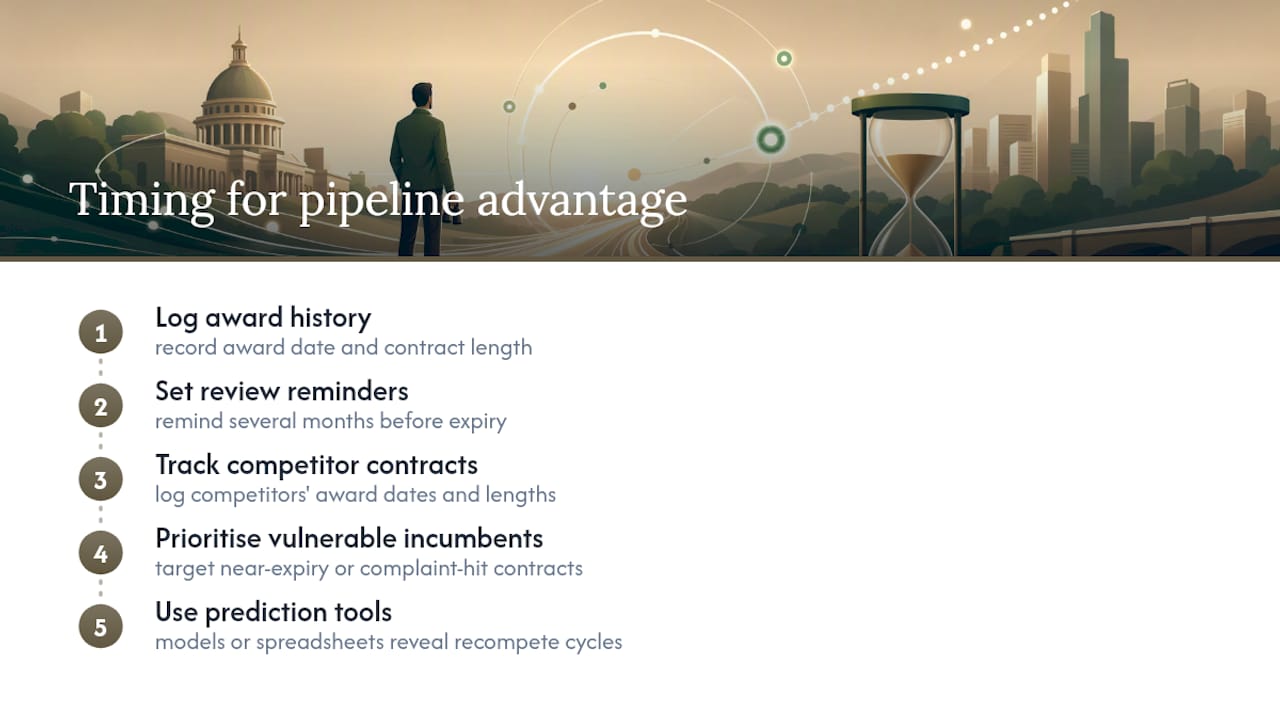
Spotting a live tender the day it publishes is already too late to compete properly. Real advantage comes from tracking the signals that appear months before a formal notice, particularly around recompetes and contract renewals.
Most public sector contracts run on fixed cycles, typically two to five years, and buyers frequently issue prior information notices well ahead of the formal tender. Suppliers who engage at that early stage see meaningfully higher win rates than those who wait for the full solicitation, largely because early engagement buys time to build relationships, refine evidence and shape pricing before competitors even start drafting.
Build a renewal tracker rather than relying on memory. For every contract you have bid on, win or lose, log the award date and expected contract length, then set a review reminder several months before that contract is due to expire. Do the same for contracts held by competitors in categories you want to enter. A vulnerable incumbent nearing the end of a five-year term, especially one that has had service complaints or short-notice extensions, is a far better target than a fresh three-year award with two years left to run.
This is also where prediction models earn their keep. Engines trained on multi-decade procurement records can surface cyclical recompete patterns that a short-window manual search would miss entirely, because some categories of contract only recur once every several years. Even without that level of tooling, a simple spreadsheet tracking award dates and durations across your target categories gives you a working pipeline months ahead of your competitors.
Turning win/loss data into a feedback loop
Every bid outcome, win or lose, contains data that improves your next submission, but only if you capture it in a structured way rather than as a scattered set of notes. Ad hoc debriefing rarely survives contact with the next deadline.
The practical fix is to tag every debrief against a fixed set of categories: pricing competitiveness, quality of evidence, clarity of methodology, and responsiveness to specific evaluation criteria. Organising debrief data into structured tags creates a feedback loop that improves future proposals faster than loose note-taking, because patterns become visible across multiple bids rather than staying locked inside a single lost tender.
Look specifically for repeat feedback. If three separate debriefs mention weak social value evidence, that is not bad luck. It is a structural gap in your evidence library that will keep costing you marks until you fix it. If your pricing consistently comes in competitive but your quality score lags, that tells you where to invest revision time before the next submission, not where to cut costs.
Set a simple rule: no bid closes, win or lose, without a debrief entry logged within a week. Momentum fades fast once a team moves on to the next deadline, and unlogged feedback rarely gets written down later.
Practical steps to embed analytics into your bid process
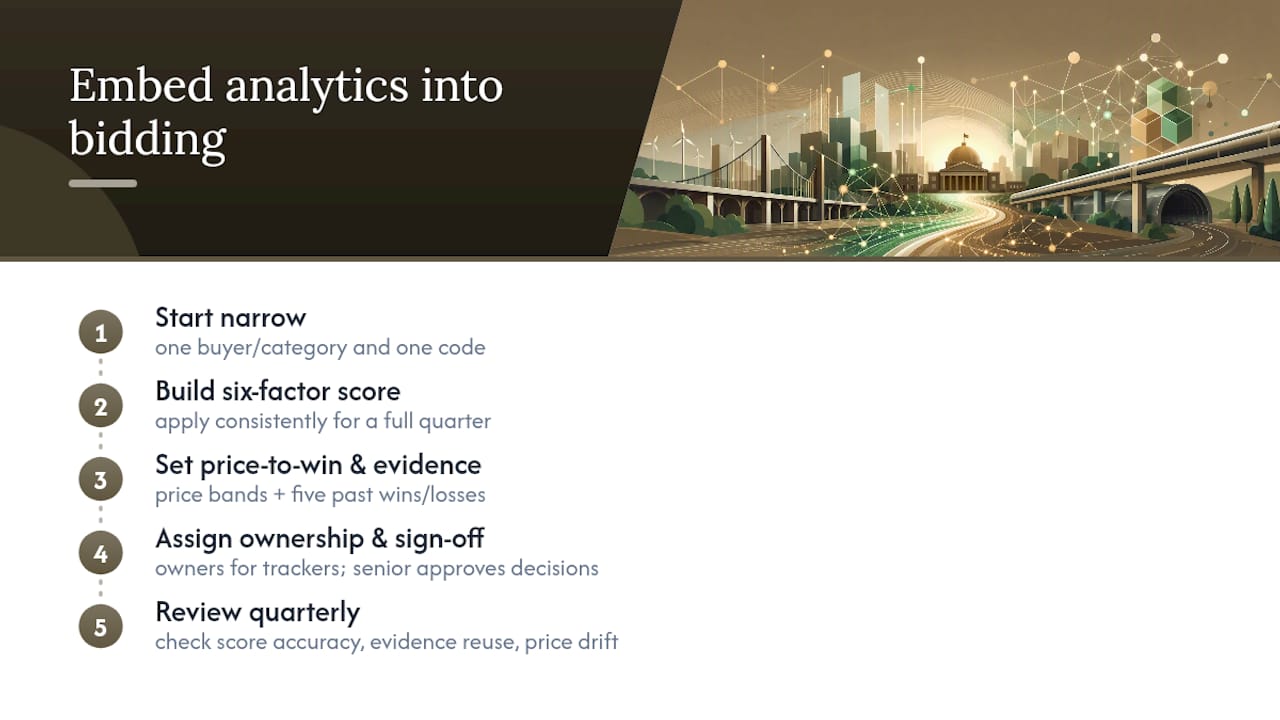
Adopting procurement analytics does not require a data science team. A minimum viable practice built around one sector, one scoring model and a small evidence index delivers measurable improvement without a major infrastructure project.
Start narrow. Pick one buyer or category and one classification code, since even small teams can extract high-value competitive signals quickly by focusing on a single agency and code rather than trying to cover every opportunity at once. Build your six-factor bid/no-bid score next, and apply it consistently for a full quarter before adjusting the weightings. Set up a basic price-to-win band using comparable awards from your chosen category, and pair it with an evidence index of your five most relevant past wins or losses.
Assign clear ownership. One person should own the buyer-history tracker, another the evidence library, and someone senior should sign off on every bid/no-bid decision so the score is not quietly overridden by enthusiasm for a big contract value. Review the whole system every quarter: which scores predicted outcomes accurately, which evidence got reused most, and where your price bands drifted from actual awards.
The order matters. Teams that try to build competitive landscape mapping, pricing models and evidence libraries simultaneously usually finish none of them well. Sequencing the build, one dataset and one habit at a time, is what separates a practice that sticks from a spreadsheet that gets abandoned after one busy month.
What limits procurement analytics in practice?
Public award data is genuinely useful, but it has real limits that bid teams need to plan around rather than discover mid-tender. The first is data lag. Award notices are not always published promptly, and some categories of contract, particularly lower-value or framework call-offs, never appear in public registers at all.
The second is inconsistency. Buyers classify contracts under CPV or NAICS codes with varying accuracy, so a search built entirely on code matching will miss relevant awards filed under an adjacent or incorrect category. Cross-checking by keyword and buyer name alongside code searches catches more of what you are looking for.
The third is that historical data describes the past, not guaranteed future behaviour. A buyer who has re-tendered every three years for a decade can still change policy, merge with another authority, or bring a service in-house. Analytics narrows uncertainty; it does not remove it.
Finally, smaller organisations often lack the resourcing to build and maintain data pipelines alongside actually writing bids. This is precisely why a workspace approach, where discovery, evidence and scoring live in one place rather than requiring a dedicated analyst, tends to suit small and mid-sized bidders better than building custom data infrastructure from scratch.
Data governance and compliance considerations for bidders
Handling procurement data responsibly matters even on the supplier side of the table, particularly once you start storing buyer information, evaluation notes and your own commercially sensitive pricing history in one system.
Keep a clear line between public award data, which is generally free to use and analyse, and any non-public information shared during a live procurement process, such as clarification answers restricted to bidders, which typically carries confidentiality obligations under the specific tender's terms. Mixing the two carelessly in shared documents can create real contractual risk.
Store evidence and past bid content with access controls that match who genuinely needs to see them. A junior bid writer drafting a technical response does not need visibility into every client's confidential pricing history from unrelated contracts. Retain records for as long as your own internal policy or contractual obligations require, and no longer, particularly where past submissions include personal data about named staff or referees.
Where a platform holds your evidence library and bid history, check how it handles data residency, access permissions and deletion requests. This is not just a compliance checkbox: a well-governed evidence library is also the one your team trusts enough to actually use, rather than working around with private spreadsheets that fragment your data all over again.
What does successful adoption of procurement analytics look like?
The pattern across organisations that make procurement analytics stick is consistency, not sophistication. Teams that succeed pick a narrow starting point, apply it rigorously, and expand only once the habit is embedded.
A small consultancy targeting local authority contracts, for example, might start by tracking every award in a single service category across a handful of neighbouring authorities. Within two or three bid cycles, patterns emerge: which authorities re-tender predictably, which incumbents show signs of vulnerability, and what price range clears the evaluation threshold. That narrow dataset, built and maintained consistently, tends to outperform a broader but shallower approach that tries to cover every category at once.
The common thread in organisations using structured procurement intelligence is discipline in capturing outcomes. Suppliers who engage early and track results systematically build a compounding advantage: each bid cycle adds to a growing dataset of buyer behaviour, competitive patterns and pricing calibration that makes the next decision faster and more accurate than the last. The advantage is not a one-off analytical trick. It comes from treating every tender, win or lose, as a data point that improves the next one.
What tools and technologies support bidder-side analytics?
Most bid teams do not need enterprise data warehouses. The practical toolkit sits closer to spreadsheets, structured tagging and purpose-built workspaces than heavyweight business intelligence platforms.
At the simplest end, a well-maintained spreadsheet tracking awards, buyer history and debrief tags can carry a small team a long way, particularly when focused on a single sector or classification code. Public registers such as national contract-award databases and framework portals provide the raw material, and pricing workflows built on public federal datasets show how far basic extraction and normalisation can go without specialist software.
At the more automated end, platforms that combine tender discovery with document analysis reduce the manual burden of scanning notices for relevance, while dedicated workspaces such as BidBlock bring discovery, requirements extraction, evidence libraries and accreditation tracking together so a bid team is not stitching together five separate tools. Prediction engines that surface recompete timing and incumbent vulnerability sit at the more advanced end of the spectrum and suit organisations bidding at high volume across many categories.
The right choice depends on bid volume. A team submitting two or three tenders a quarter rarely needs predictive modelling. A team running twenty or more live opportunities at once benefits from tools that surface priorities automatically rather than relying on manual review.
Who needs to be involved for analytics to actually work?
Procurement analytics fails when it lives with one person and nobody else trusts or updates it. Making it work across an organisation means assigning clear roles rather than hoping good intentions will keep the data current.
Bid managers own the bid/no-bid scoring and final go decisions, since they carry accountability for where writing time gets spent. Business development or capture staff maintain the buyer-history and competitive-landscape tracking, since they are usually closest to market intelligence and relationship signals. Technical authors and subject specialists feed the evidence library, tagging past project detail as it happens rather than reconstructing it under deadline pressure months later. Finance or commercial leads sign off on price-to-win bands, since they understand margin constraints that a bid writer alone cannot judge.
Senior leadership's role is narrower than it looks: protect the discipline of the scoring system rather than overriding it for large, exciting contracts that score poorly on fit. That single failure, letting enthusiasm bypass the score, undoes more analytics practices than bad data ever does.
Regular short reviews, monthly rather than annual, keep everyone's input current. A pipeline tracker that nobody updates for three months is worse than no tracker at all, because it creates false confidence in stale information.
Where is public sector procurement analytics heading?
Prediction is moving from optional extra to standard practice among higher-volume bidders. Engines trained on long historical runs of procurement records can already surface recompete cycles and cyclical opportunities that shorter-window manual searches miss, and that temporal depth advantage will keep widening as more years of award data accumulate in public registers.
Expect closer integration between discovery and drafting. Rather than separate tools for spotting a tender and writing the response, workspaces that link requirements extraction directly to evidence libraries will keep reducing the gap between finding an opportunity and submitting a strong response to it. Automated document analysis is already cutting review time meaningfully, and that trend points toward AI-assisted first drafts built directly from a supplier's own evidence, rather than generic templated language.
Social value weighting is also likely to keep growing in evaluation criteria across public contracts, which raises the value of structured, reusable social value evidence over ad hoc narrative writing. Bidders who treat social value as a tagged, trackable dataset, rather than a paragraph rewritten from scratch each time, will have a growing advantage as its scoring weight increases.
None of this replaces judgement. It shifts where judgement gets applied, from sifting through raw notices toward deciding which well-evidenced, well-priced opportunities deserve a team's limited writing time.
Author perspective: one change worth making this quarter
If you take one thing from this guide, make it a written bid/no-bid rule and hold your team to it for a full quarter before changing a single weighting. Most bid teams already collect enough data to do this; they just never force themselves to use it consistently. Start tagging debrief outcomes as structured data from your very next loss, not your next win. Losses teach more, and they get forgotten fastest. Then build an evidence index covering your next three live bids and time how much drafting effort it saves. That single measurement will do more to convince a sceptical team than any amount of theory.
Get more from your bid data with BidBlock
BidBlock is the practical way to put everything above into daily use, without hiring a data analyst or maintaining five disconnected spreadsheets. It brings tender discovery, requirements extraction, an evidence library built from your own past responses, accreditation checks and team collaboration into one workspace, so the analytics work described in this guide actually gets applied consistently rather than sitting in good intentions.

BidBlock's own clients report a 75% win rate using the platform, a figure grounded in exactly the approach this guide covers: reusing structured evidence and social value contributions instead of drafting generic responses from scratch every time. If your evidence library currently lives across old proposal files and shared drives, that is the first gap worth closing.
Plans start with a Free tier for teams testing the workflow, rising through Standard at £29 per month, Pro at £79 per month, and Max at £249 per month for higher-volume bidders. Visit the BidBlock platform to see current plan details and start applying a structured bid/no-bid process to your next opportunity.
Sources
FAQ
What is procurement analytics for public sector bidders?
It is the practice of using historical award data, buyer purchasing patterns and competitive signals to decide which tenders to pursue and how to price them. It differs from buyer-side spend analytics, which focuses on supplier performance and contract compliance rather than helping suppliers win work.
How much can procurement analytics improve win rates?
Suppliers engaging at the earliest notice stage show 30 to 45% higher win rates than those who wait for the full tender, according to Duke's analysis of large-scale procurement data. The gap comes largely from having more time to prepare evidence and pricing before submission.
What data should a small bid team track first?
Start with buyer purchasing history and award values for a single agency and classification code, since focusing narrowly yields useful competitive clarity faster than trying to cover every category at once. Add competitive landscape data and evaluation weightings once that habit is established.
How does BidBlock support procurement analytics for bidders?
BidBlock combines tender discovery, requirements extraction, an evidence library built from past responses, accreditation checks and team collaboration in one workspace. The platform's clients report a 75% win rate, a figure the company attributes to reusing structured evidence rather than drafting each response from scratch.
What is price-to-win and how do you calculate it?
Price-to-win is a method for setting a defensible price using comparable award values, normalised for scope and adjusted for evaluation weightings between price and quality. Public procurement data, similar to FPDS and USAspending registers, provides the comparable awards needed to build conservative, competitive and aggressive pricing bands.