
The quality price ratio is the weighting formula that decides who wins a public contract, not simply who submits the cheapest quote. It combines a scored assessment of quality with a scored assessment of price, using published weights, to identify the tender that delivers the best value for money. The single most important action for any evaluator is straightforward: set your weights and scoring formulas before the tender goes out, and publish them in the documents, following the Procurement Act guidance on assessing competitive tenders.
TL;DR:
- Weights and scoring formulas must be set and published before the tender to ensure transparency and consistency in evaluation.
- The quality price ratio helps identify bids that offer real value by balancing technical compliance and total ownership costs, not just the lowest price.
- Price should be scored using a consistent method, such as proportional, normalized, or total cost of ownership formulas, to ensure accurate comparisons.
- Quality scoring requires well-defined criteria, rubrics, and evidence mapping, avoiding direct scoring of raw figures for consistency.
- A documented rationale for the weighting split, based on contract risk and complexity, is essential to defend evaluation decisions and avoid legal challenges.
Table of Contents
- What does quality price ratio mean in procurement?
- How do you score price in a tender?
- How do you score quality in a tender?
- What weighting split should you use for quality and price?
- How do you calculate the final score in a weighted model?
- Governance, law, and the pitfalls that trigger challenges
- Evaluator checklist: before, during and after scoring
- What experience actually teaches evaluators about this process
- An alternative way for bidders to strengthen their quality score
- Sources
- FAQ
What does quality price ratio mean in procurement?
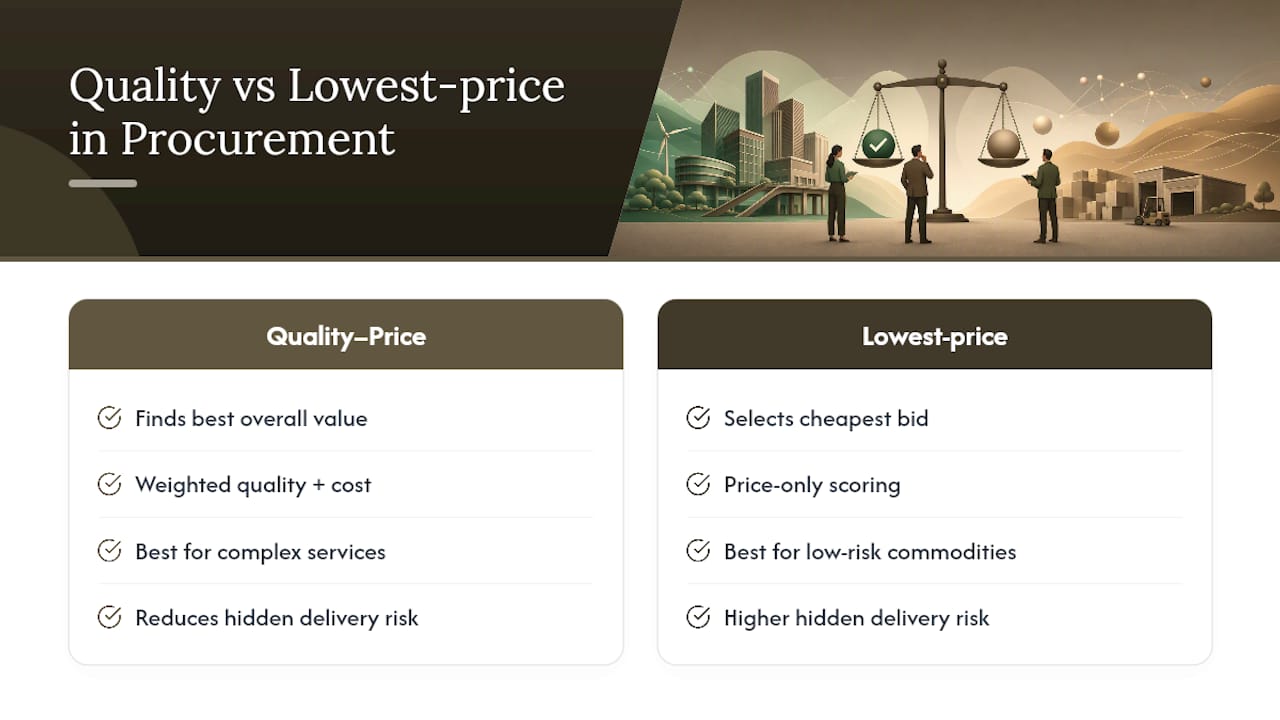
The quality price ratio, sometimes called the price quality matrix or price performance ratio, exists to identify the bid that offers the best overall value, not the one with the lowest sticker price. Contracting authorities score bids against two dimensions: how well the proposed solution meets the requirement, and what it costs. Those two scores are then weighted and combined into a single figure that ranks the bids.
This matters most where the cheapest option carries hidden risk. A facilities contract awarded purely on price can leave a council with a contractor who cuts corners on staffing or safety. A social care framework judged on cost alone can produce a provider with high staff turnover and poor continuity of care. In both cases, the quality price ratio exists to catch what the price tag hides.
Lowest-price award still has its place. For straightforward, low-risk commodity purchases, where products are genuinely interchangeable, a price-only approach can be defensible and quicker to run. But for complex services, high-risk purchases, or anything where outcomes depend on capability and delivery, not just unit cost, quality has to carry real weight.
The concept sits close to value for money and total cost of ownership. Value for money asks whether the price paid is justified by what is delivered; total cost of ownership extends the price assessment beyond the purchase price to running costs, maintenance and disposal. The Procurement Act 2023 e-learning sets out the formal expectations contracting authorities must follow when applying these principles, and it is the first place any evaluator should check before designing a scoring model.
How do you score price in a tender?
Price scoring needs to produce a comparable number, not just a ranked list of quotes. Three methods dominate UK public tenders, and each has a distinct effect on how much a low bid gets rewarded.
- Lowest-price proportional formula. The cheapest compliant bid gets the maximum price score; every other bid is scored as (lowest price ÷ that bid's price) × maximum score. A £90,000 bid against a £100,000 maximum-score bid of £100,000 scores 90% of the available price points.
- Inverted or normalised scoring. Prices are converted onto a common scale, often using the highest and lowest bids received as the range boundaries, which reduces the disproportionate reward the simple proportional formula gives to unusually low outliers.
- Total cost of ownership. Where running costs, maintenance, energy use or disposal costs matter, the price score is built from the whole-life cost rather than the headline purchase price, which stops a low upfront price from masking expensive years of ownership.
Practical consistency matters as much as the formula itself. Set a single base price for comparison (net of VAT, generally), decide up front how optional extras and variable-rate items are treated, and apply one rounding rule across every bid. Evaluators who let bidders present costs in slightly different formats almost always end up comparing numbers that are not actually comparable.
How do you score quality in a tender?
Quality scoring turns judgement into numbers, and that conversion is where most evaluation panels run into trouble. The starting point is choosing criteria that map directly onto the specification and the outcomes that matter, rather than generic categories borrowed from a previous tender.
Typical quality criteria for a public sector award include:
- Technical compliance with the specification
- Delivery methodology and mobilisation plan
- Capability and relevant experience of the proposed team
- Social value contribution and community benefit
- Risk management and contingency planning
Each criterion needs a rubriced desirability scale, commonly 1 to 5, with a written description of what each point on the scale actually looks like. A response that "fully exceeds requirements with clear evidence" might score 5; one that "partially meets requirements with gaps" might score 2. Evidence should be scored against that rubric, not against a gut feeling: samples, test results, case studies, references and CVs all count, provided the panel has agreed in advance what "good" evidence looks like for each criterion.
One point trips up more evaluators than any other: raw technical figures should never be scored directly. Map the raw figure onto the desirability scale first, based on what the specification actually needs, then score the mapped value. A compliance matrix built directly from the tender requirements makes this mapping far easier to apply consistently across every submission.
Pro Tip: Score one "reference" bid as a panel before scoring the rest individually. It calibrates everyone's interpretation of the rubric and catches wildly divergent scoring before it becomes a challenge risk.
What weighting split should you use for quality and price?
There is no universal correct split, but there are strong rules of thumb that most experienced evaluators apply consistently.
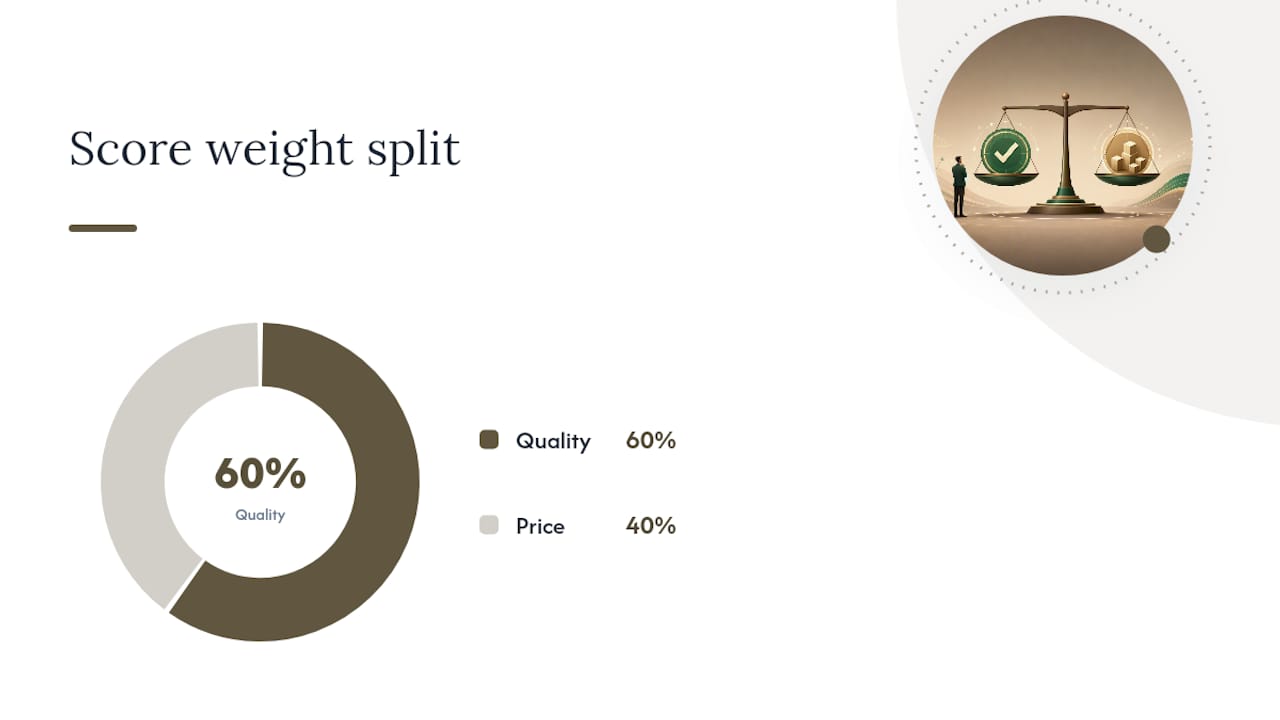
- 60/40 or 70/30 in favour of quality suits complex services, clinical or safeguarding-critical contracts, and anything where poor delivery creates reputational or safety risk.
- 50/50 works for mid-complexity purchases where price and delivery capability matter roughly equally, such as many construction or facilities contracts.
- 40/60 or 30/70 in favour of price fits standardised goods and low-risk commodity purchases where genuine differentiation between bidders is limited.
The chosen split needs a documented rationale, not just a number picked because it "feels right". Write down the risk profile of the contract, how critical the service is to service users, and how sensitive the outcome is to cost overruns; that record is what defends the decision if a losing bidder challenges the award. For frameworks or contracts split into lots, apply the logic separately to each lot rather than forcing one split across dissimilar requirements. A cleaning lot and a specialist clinical lot within the same framework rarely justify identical weightings.
How do you calculate the final score in a weighted model?
Every weighted scoring model reduces to the same formula: multiply each bid's quality score and price score by their respective weight, then add the two weighted figures together. The bid with the highest combined total wins, assuming it also clears any minimum quality threshold set in the tender documents.
Price score = (lowest compliant price ÷ bid price) × 100 Quality score = average panel score across criteria, converted to a percentage Weighted total = (quality score × quality weight) + (price score × price weight)
Take a 60/40 quality/price split across three hypothetical bids for a support services contract:
- Calculate each bid's raw price score using the lowest compliant price as the benchmark.
- Convert panel quality marks into a percentage score against the rubric.
- Apply the agreed weights and sum the two weighted figures.
- Rank the totals; Bid C wins here despite not being the cheapest, which is exactly the outcome a weighted scoring model is designed to produce.
If a small adjustment flips the winner, the margin is too thin to defend without scrutiny, and the panel should review scoring notes before signing off. Store every scoresheet, rationale note and calculation alongside the tender record, since this is what a challenge or audit will ask to see first.
Governance, law, and the pitfalls that trigger challenges
The legal anchor for award decisions sits in the Procurement Act guidance on assessing competitive tenders and, for procurements still running under the older regime, Regulation 69 of the Public Contracts Regulations, which sets out transparency expectations at award stage. Both require contracting authorities to document their evaluation methodology and be able to show it was applied consistently.
Most challenges trace back to a small set of recurring errors:
- Changing weightings or criteria after tenders have been submitted, even informally
- Accepting different types or depths of evidence from different bidders for the same criterion
- Failing to disclose the scoring methodology in the original tender documents
- Letting one evaluator's scores diverge sharply from the panel without a documented reason
Mitigation is procedural rather than clever: run a calibration session before scoring begins, pre-publish the full scoring matrix with the rubric descriptions, and require sign-off from a second reviewer on any score that sits well outside the panel average. Keep every rationale note, scoresheet and communication with bidders, since redacted versions of these records are increasingly expected to be published after award.
Evaluator checklist: before, during and after scoring
- Pre-evaluation: confirm the weighting split is signed off, finalise the rubric wording for every criterion, and have every panel member declare conflicts of interest.
- During evaluation: run a calibration exercise on one sample bid, flag any scoring inconsistency immediately, and write a short rationale for every score, not just the low or high outliers.
- Post-evaluation: run the sensitivity check on the final rankings, get panel sign-off on the record, and prepare the redacted version for publication.
Pro Tip: Keep one "reference" bid on file from a previous, well-scored tender. Reusing it to calibrate a new panel takes twenty minutes and saves hours of rescoring later.
What experience actually teaches evaluators about this process
Rigour and speed pull against each other in most live evaluations, and the honest answer is that rigour has to win the argument every time it comes up. One recurring trade-off: a panel under time pressure wants to skip the calibration round on the first criterion. Skipping it once, in most cases I have seen described in procurement guidance, produces a spread of scores wide enough to need a second full read-through anyway, which costs more time than the calibration would have. The fix is boring but effective: build calibration into the timetable from the start, not as an optional extra. Training through the official Procurement Act e-learning and using repeatable scoring templates does more to protect an award decision than any amount of last-minute checking.
— Syed
An alternative way for bidders to strengthen their quality score
Everything above describes how evaluators score a bid. Bidders sit on the other side of that process, and the quality score usually comes down to one thing: whether the evidence in the response is specific, consistent, and easy for a panel to verify against the rubric. Vague claims about "proven experience" score poorly against a desirability scale; a named case study with dates, outcomes, and a client reference scores well.

A platform exists that organises an organisation's past bid evidence, case studies and social value contributions into a searchable library, checks which accreditations are current before a submission goes out, and helps structure responses so each answer maps directly onto the evaluation criteria rather than drifting off-topic. If you are preparing responses against a published weighting split and want your quality evidence organised before the deadline rather than the night before, start with the Bidblock plans and see which tier fits your current bid volume.
Sources
- Assessing competitive tenders (Procurement Act guidance)
- Legislation
- What is a weighted scoring model for quotes? | Buyer24
- I analysed 1,434 products to see if price predicts quality. It doesn't
FAQ
What is the CP ratio?
The CP ratio, or cost to quality ratio, measures what a buyer receives in quality terms relative to what they pay, expressed either as a scored comparison or a simple cost-per-unit-of-quality figure. In UK public procurement it is applied through the weighted scoring model set out earlier, rather than a single fixed formula.
What is the relationship between price and quality?
Price and quality are only weakly linked. Cross-category analysis of more than 1,400 products found price is a poor predictor of independently assessed quality, which is exactly why procurement evaluations score quality directly rather than assuming a higher price guarantees a better outcome.
What is the price ratio in tender scoring?
The price ratio is the proportion used to convert a bid's price into a comparable score, most commonly calculated as the lowest compliant price divided by the bid price, multiplied by the maximum available price score. It sits alongside the quality score once both are weighted and combined into the final ranking.
What is a good price to quality weighting split?
There is no single correct split; it depends on contract risk and complexity. A 60/40 or 70/30 lean towards quality suits complex or high-risk services, while a 50/50 or price-weighted split suits standardised, low-risk commodity purchases, as outlined in the weighting section above.
Does Bidblock help with quality scoring on tenders?
Bidblock does not score tenders on behalf of buyers, but it helps bidders present the evidence that feeds into a panel's quality score, organising past case studies, accreditations and social value evidence into structured, reusable responses. Current plans and pricing are listed on the Bidblock site.